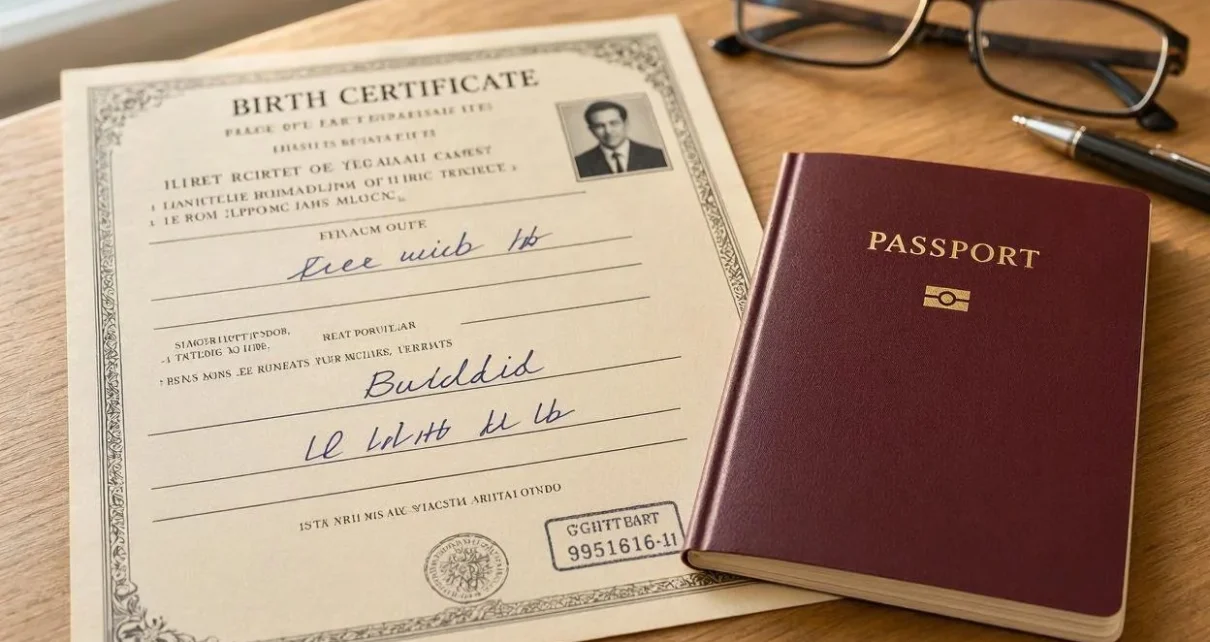
Passport officials assess citizenship evidence alongside identification and application details, requesting additional documentation when inconsistencies raise questions about a birth certificate’s authenticity, the information it contains or its connection to the person seeking a passport.
WASHINGTON, DC, October 4, 2026 — A qualifying American birth certificate can establish citizenship evidence for a passport application, but submitting that document does not eliminate the separate requirements to establish identity, complete the application and satisfy the conditions applicable to issuance.
The distinction matters because a birth certificate records birth information, while passport officials must evaluate a present-day applicant, connect that person to the historical record, and determine whether the overall application supports issuing the requested document.
For many applicants, that connection is straightforward, but a missing detail, an unexplained name difference or a question about the document’s origin can require clarification without necessarily suggesting that the applicant has attempted fraud.
Understanding what a birth certificate establishes, and what other evidence must establish, helps explain why a document accepted as citizenship evidence is an important component of an application rather than an independent guarantee of passport approval.
Citizenship Evidence Is One Part of the Application
The State Department’s citizenship-evidence guidance identifies a qualifying United States birth certificate as primary evidence for applicants born domestically, while specifying requirements concerning the issuing authority, registration information, and identifying details included on the document.
Those requirements include the applicant’s name, date and place of birth, parents’ names, the registrar’s signature and an official seal or stamp, with timely registration forming part of the published requirements for primary birth-certificate evidence.
The department also describes secondary evidence options when primary evidence is unavailable, meaning an unavailable or insufficient birth certificate does not automatically establish that the person lacks citizenship or cannot complete an application.
These distinctions should prevent two opposite misunderstandings: that any paper labeled a birth certificate guarantees a passport, or that an applicant whose records require additional explanation must necessarily be ineligible for the document being requested.
An Accepted Document Has a Defined Purpose
The useful question is what a particular document proves in the application, because accepting a record for one purpose does not mean that the same record also satisfies every other factual and procedural requirement.
A birth certificate may address the circumstances of a person’s birth, but it generally does not show the adult applicant’s current appearance or explain every change in the person’s identifying information since childhood.
That gap becomes easier to understand when the application is viewed as a connection between historical evidence and a living individual, rather than a transaction in which possession of one important document automatically produces another.
For legitimate applicants, the objective is to make that connection clear through accurate information and appropriate supporting records, allowing officials to assess the application without assuming the document’s presenter and its subject are necessarily identical.
Proving Identity Requires a Connection to the Applicant
State Department identification guidance for adults applying in person calls for physical photo identification and a photocopy, reflecting the separate need to establish who is presenting the application and how that person relates to the submitted evidence.
The department lists acceptable primary identification documents and provides alternatives in specified circumstances, so applicants should follow the instructions relevant to their situation rather than assume that a birth certificate substitutes for the identification requirement.
This distinction matters because someone other than the rightful subject can possess an authentic document, so the physical presence of a genuine record is insufficient to establish the presenter’s entitlement to use its information.
An applicant’s appearance, identifying details and supporting records therefore contribute different kinds of evidence, and the practical value comes from their relationship rather than the number of documents placed together in an application package.
Authenticity and Ownership Are Separate Questions
Document authenticity asks whether a record genuinely comes from the authority it purports to represent, while ownership asks whether the person relying on that record is the individual described in it or otherwise authorized to use it.
A genuine certificate belonging to another person raises a different concern than an altered certificate, because one involves the relationship between applicant and record while the other challenges the record’s reliability.
These differences also explain why a document’s official appearance cannot resolve every question, since a seal or certification concerns the record and does not independently establish the current identity of whoever presents it.
For applicants and advisers, keeping those questions separate makes problems easier to diagnose, because obtaining a replacement certificate may address a document issue while leaving an unrelated identity discrepancy that still needs its own explanation.
A Maine Prosecution Illustrates the Identity Problem
An August 2023 Associated Press report about Napoleon Gonzalez described his conviction on charges including passport fraud after authorities said he used his deceased brother’s identity to obtain passports and other benefits over an extended period.
According to that reporting, Maine motor-vehicle facial recognition technology linked the same face to different identities in 2020, triggering an investigation that showed how a person’s claimed documentary identity can differ from their actual identity.
The case should not be interpreted as evidence that every birth certificate receives the same technological examination, or that a particular screening method alone determines passport eligibility, because the reported investigation involved several kinds of evidence.
Its relevance lies in the distinction between a person and an identity claim, showing why officials cannot reasonably treat records associated with a name as conclusive proof that the applicant owns that identity.
Names Can Change Without Changing the Person
A birth certificate often reflects information recorded long before an adult applies for a passport, creating an understandable need to explain later changes when the application or identification documents use a different name from the original record.
Marriage, divorce or a legally documented name change can create a legitimate difference between records, and the appropriate response is to establish continuity through the required documentation rather than treat the difference itself as proof of deception.
State Department passport correction and name-change guidance describes procedures that depend on the circumstances, reinforcing the importance of using the instructions appropriate to the requested action rather than assuming every name discrepancy follows an identical process.
An applicant should therefore distinguish between explaining a genuine change and correcting an actual error, because those situations may involve different records even when both appear initially as a mismatch between names on official paperwork.
Consistency Does Not Mean Every Record Must Be Identical
A coherent documentary history can include fully explained differences, so the key question is whether the records can be reliably connected, not whether every document repeats the same name or other information.
For example, a historical record and a current identification document may serve different purposes at different points in a person’s life, making the evidence linking them more informative than an unsupported demand that their contents match perfectly.
The same reasoning applies when reviewing an application for possible fraud, because a discrepancy raises a question that needs answering but does not, by itself, establish why the difference exists or whether anyone intended to mislead officials.
Applicants should avoid trying to make records appear artificially consistent, since a truthful explanation supported by appropriate documentation preserves the distinction between a legitimate change and an unauthorized alteration of an official record’s contents.
An Incomplete Record Is Different From a False Record
A certificate can be insufficient for a particular application without being counterfeit, especially when the version supplied lacks required information or does not provide the evidence needed to resolve the specific issue officials are examining.
That distinction matters to families who have retained an old document for years and reasonably regard it as authoritative, only to discover that the passport application requires a different official copy or additional supporting material.
The appropriate next step is to identify the exact deficiency before seeking a replacement, because ordering another copy of the same unsuitable version may leave the underlying problem unresolved and create additional expense or delay.
Applicants should obtain official records through the responsible issuing authority and follow its correction procedures when necessary, rather than editing a scan, adding missing information themselves or assuming that private certification cures a substantive error.
Historical Records Can Require Additional Context
Older family records can raise practical questions about how information was recorded and preserved, making careful explanation useful even when there is no reason to believe that the applicant or the original recordkeeper acted dishonestly.
A delayed or incomplete record should therefore be considered in the context of the applicable evidence requirements, with the applicant focusing on what additional material is requested rather than speculating about the government’s view of their motives.
The distinction between evidence and intent matters here because proving the circumstances necessary for issuance is a different task from establishing that someone knowingly submitted a false statement or deliberately used fabricated paperwork.
For reporting and public discussion, describing the actual problem precisely helps protect that distinction, whether officials have requested another record, questioned a document’s authenticity or announced a criminal allegation supported by a separate investigative process.
Children’s Applications Show Why More Evidence Is Necessary
Applications for children under 16 clearly show why a birth certificate cannot complete the process alone, because the department also evaluates the relationship between the child and the adults involved in the application.
Current State Department instructions generally require the child and both parents or guardians to appear together, with additional documentation required when one or both adults cannot attend, alongside the other evidence needed for the application.
A birth certificate can help establish a parental relationship, but it does not automatically answer every question about consent, guardianship, or a particular adult’s authority to act in the child’s passport application.
Families should therefore review the child-specific requirements before an appointment, especially when custody arrangements or a parent’s absence affect the application, because citizenship evidence and the authority to apply address separate concerns within the process.
Applicants Born Abroad Face a Different Evidence Question
A foreign birth certificate records a birth under the issuing jurisdiction’s system, but its existence alone does not establish American citizenship, so applicants must identify the actual basis for any United States citizenship claim.
The State Department’s published examples for people born outside the United States include a Consular Report of Birth Abroad, a Certificate of Naturalization, a Certificate of Citizenship, and a qualifying prior American passport, depending on the applicant’s circumstances.
This difference concerns what the evidence establishes, not whether foreign records are inherently less trustworthy, since an authentic document can establish a birth abroad while leaving the separate citizenship question unresolved in an American application.
People with international family histories should therefore organize their records around the citizenship basis being claimed, avoiding the assumption that a collection of foreign documents necessarily answers the specific questions relevant to obtaining a United States passport.
Additional Information Requests Need a Focused Response
State Department guidance explains that applicants may receive a letter, email or telephone call when more information is needed, and that processing can be delayed until the requested response or documentation has been received.
A request for information should be read for the precise issue it identifies, because the appropriate response to missing citizenship evidence may differ from the response required for identification, a name discrepancy, or another application problem.
Applicants should follow the instructions and deadline in the actual correspondence, and keep copies of what they submit so any subsequent discussion can refer to the same documents and accurately describe what has already been provided.
If the request is unclear, seeking clarification through an official contact channel is more useful than submitting unrelated material, because additional paperwork helps only when it addresses the question preventing officials from completing their review.
A Processing Delay Does Not Establish Fraud
A delay provides limited information about its cause, so applicants and outside observers should avoid treating an unresolved application as proof that officials have concluded the birth certificate is false or the applicant is dishonest.
Similarly, a request for more evidence does not, by itself, communicate a final decision about citizenship, because the purpose of obtaining additional information may be to resolve a question the existing submission does not adequately answer.
When an application raises a substantial legal issue, qualified counsel can explain the relevant requirements and organize an accurate response, although professional assistance cannot guarantee issuance or replace evidence the applicant must provide.
International Planning Requires Clear Documentary Boundaries
People considering additional citizenship or relocation may encounter several kinds of government records, so it’s especially important to distinguish a birth record, citizenship determination, passport, and administrative identifier by the function each serves.
Amicus International Consulting’s second-passport services page discusses additional citizenship and passport planning, a field in which applicants should verify the lawful basis of eligibility and understand which government authority makes the relevant citizenship and document-issuance decisions.
A lawful application depends on accurate facts and valid supporting evidence, so advisers should explain how a proposed process establishes eligibility rather than suggest that possession of a newly issued certificate automatically resolves every identity or nationality question.
The same care applies to Amicus International Consulting’s tax identification number services, because a tax identifier serves an administrative purpose and should not be presented as independently establishing nationality or entitlement to a particular country’s passport.
For clients reviewing a proposed document package, the useful question is what each item legally demonstrates, allowing them to distinguish evidence supporting a genuine claim from paperwork that merely repeats information without establishing the underlying entitlement.
Preparing a Complete Application Starts With the Right Questions
Before applying, an applicant can separate the task into establishing the citizenship basis, confirming identity, explaining relevant differences between records, and meeting the requirements for the specific application category, including any child-specific or name-change documentation.
Reviewing those questions early creates an opportunity to obtain missing records before travel plans become urgent, while also reducing the temptation to interpret an ordinary documentary problem as something that requires an unofficial or improvised solution.
Careful preparation should include checking current government instructions, preserving the accuracy of every submitted record, and ensuring explanations describe the applicant’s actual circumstances rather than an assumed history constructed to make the paperwork look simpler.
A birth certificate remains valuable evidence within that process, but its significance depends on what it establishes and how it connects to the applicant, with passport eligibility ultimately assessed through the complete application and its supporting information.