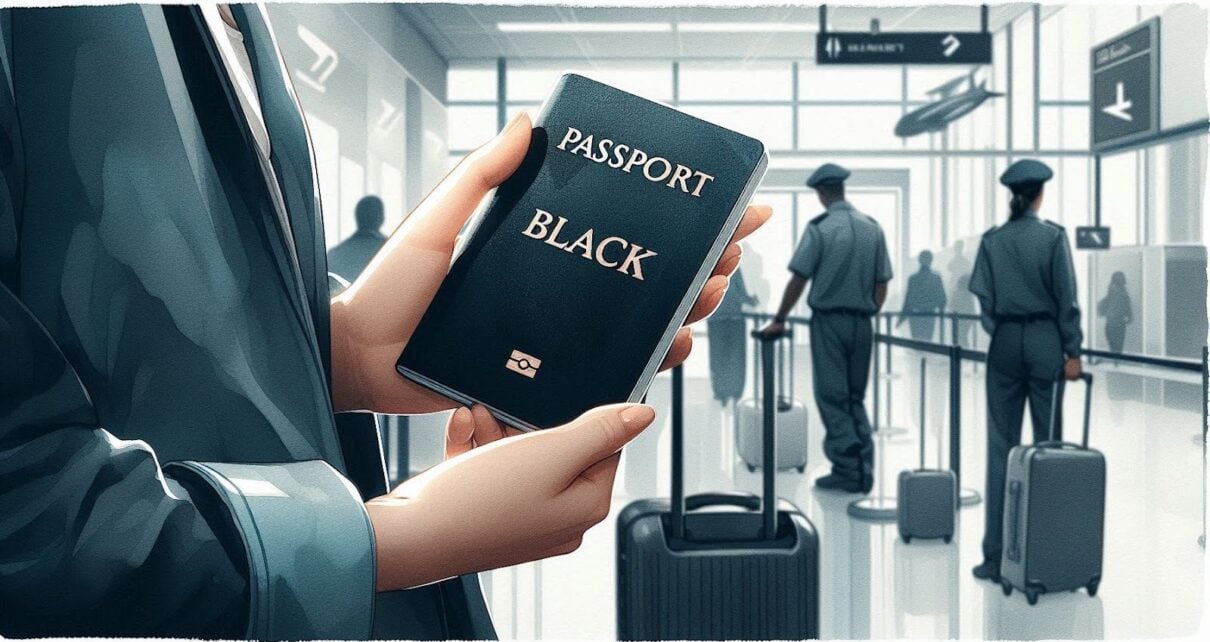
Black passports are uncommon, but they stand out for formality, durability, and national symbolism, which is why the world’s darkest passport covers tend to be chosen very deliberately rather than casually.
WASHINGTON, DC.
For most travelers, a black passport looks more dramatic than a blue, red, or green one, because the color carries instant associations with authority, gravity, discretion, and state power that lighter covers rarely project as convincingly.
That visual force is exactly why black remains one of the least common passport colors in the world, since governments usually reserve it either for highly symbolic ordinary passports or for special documents linked to travel for diplomatic, official, or state service.
In other words, black is not rare because it failed, but because it became too powerful a design signal to use casually, especially in systems where passport color helps distinguish ordinary citizenship from official rank.
Black became a color of authority before it became a travel curiosity.
Modern passport covers do more than protect the pages inside; they also indicate what kind of state document is being presented before a border officer, consular worker, airline clerk, or hotel compliance desk opens it.
Black performs that job unusually well, because it looks formal, severe, and unmistakably official while also giving gold crests, national emblems, and embossed lettering a strong contrast that reads clearly under hurried inspection.
That is one reason black appears repeatedly in diplomatic and official passport categories, including within the United States, where the State Department’s Special Issuance Agency handles government travel documents through its special issuance passport procedures.
The American example matters because it reinforces a broader global pattern in which black signals state representation, controlled access, and a category of travel connected more closely to government functions than to ordinary tourism.
Across multiple countries, black therefore developed a reputation as the color of seriousness, a visual shorthand suggesting the holder is carrying a document that belongs closer to state protocol than to everyday leisure movement.
Rarity itself became part of the black passport’s appeal.
Once most countries settled into the more common families of blue, red, and green covers, black acquired a different kind of value, because scarcity made it look more deliberate, more curated, and more symbolically charged.
That scarcity still stands out in modern global passport comparisons, where black covers remain a small minority compared with the dominant blue, red, and green groups that most travelers encounter far more often at airports and consulates.
For a government deciding whether to use black, the rarity can be an advantage rather than a drawback, because the color makes a booklet feel distinct without requiring a complicated visual redesign or unfamiliar national branding experiment.
A dark cover also photographs well, appears elegant in ceremonial contexts, and gives the passport a prestige effect that many states may find useful when they want their document to project restraint rather than exuberance.
That helps explain why commentary on passport aesthetics, including a widely read Forbes analysis of passport colors and their symbolism, continues returning to black whenever the conversation turns to exclusivity and formal state image.
For many countries, black signals rank more than nationality.
One of the clearest reasons black passports are rare is that many governments prefer to use them selectively, assigning them to diplomatic or official passport classes rather than to the ordinary booklet held by the general public.
That approach lets a state create a visible hierarchy within its travel documents, so that the cover color itself begins communicating whether the traveler is moving as a private citizen, an official representative, or a formally accredited envoy.
The United States is one prominent case, but it is far from alone, because official reciprocity records describe black diplomatic or official passport categories for multiple countries whose ordinary civilian passports use entirely different colors.
Romania’s diplomatic passport is black while its ordinary passport is red; Brunei’s official passport is black while its ordinary passport is red; and other systems use black in similar ways to distinguish state service from civilian identity.
That pattern matters because it shows that the meaning of black is often institutional rather than purely national, with the color functioning as a marker of office, protocol, and governmental purpose rather than a broad public identity.
It is also why the black passport has become entangled in public fascination with diplomatic travel, special status, and border privilege, even though the document itself does not automatically confer immunity or unlimited protections.
That distinction remains crucial in practice, and it is the same point emphasized in Amicus’s analysis of diplomatic passports and immunity, which explains that accreditation and legal status matter more than the cover alone.
A small number of countries made black part of ordinary national branding.
Black passports are not confined to elite categories because a small cluster of countries has chosen black for ordinary travel documents, turning the color into a more general expression of national identity.
New Zealand is the example many travelers recognize first, since black is deeply embedded in the country’s wider visual culture and has long been treated as an iconic national color rather than a narrow diplomatic symbol.
In cases like that, black serves not as an elite badge but as a branding decision, allowing the passport to mirror the broader national palette, much as other states lean toward blue for regional identity or green for religious heritage.
A handful of other countries have used black ordinary passports as well, proving that the color can support public issuance, yet the group remains small enough that black still reads as distinctive whenever it appears in a traveler’s hand.
That limited adoption is part of the meaning, because once only a few countries use black for standard passports, the color acquires an aura of deliberate national self-definition instead of drifting into routine administrative sameness.
Black survives because it is elegant, practical, and hard to cheapen.
Passport design is not only about symbolism, because a document that travels through pockets, bags, immigration booths, and years of handling must also remain presentable after repeated physical stress.
Black succeeds at that practical level because it hides scuffs better than many lighter covers, preserves a formal appearance even with heavy use, and makes metallic lettering appear crisp, helping official design elements stand out.
Those practical strengths are one reason the color can endure across redesigns, because authorities may modernize biometric chips, polycarbonate data pages, and anti-counterfeiting architecture without seeing any reason to abandon a cover that still looks authoritative.
That is especially true in an era when passport security increasingly depends on internal technology rather than exterior color, meaning a traditional black cover can remain visually unchanged while the inside becomes much more sophisticated.
As Amicus explains in its overview of the modern components that make passports secure, the decisive protections now come from biometrics, machine readability, and layered anti-fraud features rather than cosmetic presentation alone.
Yet cosmetic presentation still matters, because border processing begins with a physical object in a human hand, and the first impression of that object still shapes assumptions about seriousness, category, and institutional order.
Most governments avoid black precisely because it is so strong.
If black were used everywhere, it would lose much of the prestige and category value that currently makes it attractive for diplomatic issuance and carefully managed national branding.
Many states instead choose colors that align more comfortably with regional blocs, religious symbolism, or long-established ordinary-passport conventions, leaving black available for narrower uses where visual distinction really matters.
Blue works well for countries that want a stable civilian default, red often aligns with European and historical traditions, and green remains powerful where religious or regional symbolism already gives it public legitimacy.
Black, by contrast, can feel too formal, too severe, or too elite for a mass civilian document unless the country has a compelling branding reason or a strong tradition that makes the choice feel organic.
That is why black passports tend to be memorable whenever they appear: the color is usually associated either with a very specific state purpose or with a national identity confident enough to carry such a stark design.
In visual terms, black tells the world that the issuing authority does not need ornament to convey seriousness, and that minimalist authority is part of the reason the color keeps its mystique.
The irony is that black remains effective largely because most governments decline to use it, allowing the handful that do adopt it to preserve a visual language of rarity, discipline, and unmistakable official presence.
Black looks powerful, but it does not guarantee power.
Online discussions about passport colors often drift into mythology, with people assuming that a black passport must automatically be stronger, more privileged, or more globally useful than passports using more common shades.
That conclusion does not hold up under serious analysis because passport power depends on visa arrangements, consular relationships, issuing-state credibility, and document security, none of which can be reliably inferred from the cover color alone.
A black passport may belong to a highly mobile traveler, a government official with narrow mission-specific privileges, or a citizen of a country that simply chose a distinctive aesthetic for historical and branding reasons.
The color, therefore, says much more about how a state wants its document to feel than about how many borders it will open, which is why visual symbolism and travel utility should never be treated as the same question.
This matters especially in public conversations about diplomatic passports, where the black cover can encourage exaggerated assumptions about arrest immunity, customs treatment, or legal protection that the holder may not actually possess.
The better reading is more restrained, because black announces seriousness and sometimes status, but the real legal meaning comes from the holder’s recognized role, the issuing country’s rules, and the receiving state’s obligations.
Why the rarest passport color gets chosen.
Black passports get chosen because black does something few other cover colors can do with equal force, projecting dignity, exclusivity, durability, and official gravity in a single visual gesture that needs almost no explanation.
Governments use that effect selectively because the stronger the symbolism, the more useful it is for documents that must appear elevated above the ordinary stream of civilian travel or be unusually tied to national identity.
When a country wants a passport to feel ceremonial, authoritative, or unmistakably branded, black offers a ready-made solution, especially when gold insignia, formal typography, and state emblems are central to the visual language.
When a country wants to separate diplomatic or official travel from ordinary travel, black also works extremely well because the contrast with red, blue, or green civilian booklets creates an immediate and readable administrative distinction.
That is why the world’s rarest passport color continues to survive in 2026, not as a curiosity from the margins, but as a deliberate design choice reserved for moments when governments want the cover itself to communicate rank, symbolism, and control.