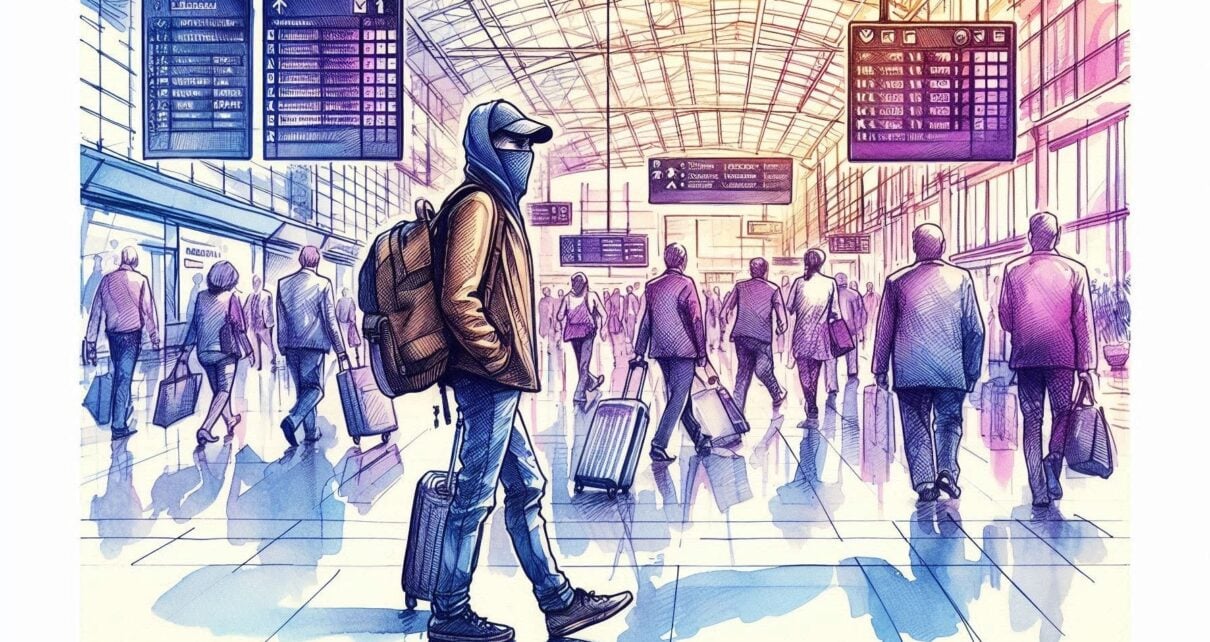
The EES transition is reshaping Schengen travel, but the biggest impact falls on non-EU frequent flyers, whose border crossings are now increasingly defined by biometric registration, digital records, and verified identity systems.
WASHINGTON, DC
Europe’s familiar passport-stamp era is ending, and the transition is creating confusion for travelers who still think of Schengen border control as a quick glance, a thump of ink, and a silent walk toward baggage claim.
The phrase “red passport holders” has become shorthand for European mobility, but the new Entry/Exit System does not target EU citizens traveling on EU passports in the same way it targets non-EU nationals entering Schengen for short stays.
The real change is that non-EU travelers, including Americans, Canadians, Britons, Australians, and many other visa-exempt visitors, are now being processed through digital entry and exit records that replace manual passport stamps with biometric border registration.
The EES does not end free movement for EU citizens, but it does change the border environment around them.
EU citizens and other travelers with Schengen free-movement rights are not the primary population registered in the EES, as the system is designed to record short-stay entries, exits, and refusals of entry for non-EU nationals crossing external Schengen borders.
That distinction matters because many travelers hear “European digital border system” and assume that every red passport holder will be enrolled in the same biometric process, when the system is actually aimed at third-country nationals.
The European Commission’s official explanation of the Entry/Exit System becoming fully operational states that passport stamps are being replaced with digital records for non-EU nationals coming for short stays, including facial images, fingerprints, and travel-document data.
For EU passport holders, the impact is more indirect: longer airport flows, redesigned terminals, shared biometric infrastructure, new queue management systems, and a border environment increasingly built around automated identity verification.
Frequent non-EU flyers will feel the change first.
The traveler most affected is not the EU citizen moving between member states, but the non-EU frequent flyer who enters and exits Schengen often enough to notice every delay, enrollment requirement, automated gate, and system mismatch.
Under the new model, short-stay travelers are digitally recorded instead of stamped, meaning the system calculates entries and exits more accurately and tracks the familiar 90-days-in-any-180-days rule with far less reliance on manual officer review.
That is a major change for business travelers, remote professionals, second-home owners, touring artists, sports staff, journalists, consultants, and high-frequency visitors who previously relied on stamped pages and personal calendar discipline.
The new reality is simple: Schengen travel is becoming less about what appears in the booklet and more about what appears in the database.
Digital Travel Credentials are not formally mandatory for every frequent flyer, but the direction of travel is clear.
The claim that Digital Travel Credentials are now mandatory for all frequent flyers should be treated carefully, because EES and DTC are related parts of the digital-border future, but they are not the same system.
EES is the Schengen entry and exit database for non-EU short-stay travelers, while Digital Travel Credentials are a broader identity framework that can allow travel-document data to be verified digitally before or during a journey.
In practice, however, the two systems are moving in the same direction because frequent travelers will increasingly be expected to use digital pre-verification tools, mobile identity flows, biometric gates, and automated processing wherever available.
The paper passport remains essential, but it is no longer the whole story, because airports are now designing the passenger journey around the face, the chip, the phone, and the system record.
The June 2026 pressure point is operational, not legal.
By June 2026, the issue is not that every traveler suddenly loses access without a DTC, but that airports and border authorities are entering the first peak summer season after the EES is fully operational.
That matters because summer travel exposes every weakness in a border system, including enrollment bottlenecks, biometric capture delays, family-processing problems, airline document checks, transfer congestion, and confusion among travelers who did not prepare.
Recent travel coverage has already described delays, temporary easing of checks, and airport strain as countries adapt to the new EES environment, with some southern European airports facing pressure from heavy holiday flows and biometric processing demands.
The early lesson is that digital borders may be faster once travelers are enrolled, but the transition period can feel slower because every new system must absorb millions of people learning it for the first time.
The old passport stamp was imperfect, but travelers understood it.
The stamp was crude, visible, and sometimes inconsistent, but it gave travelers a physical reminder of when they entered and left the Schengen Area.
That mattered for people tracking their 90-day limit, proving travel history, correcting mistakes, or simply understanding their own movement through Europe without logging into a system.
EES replaces that visible record with digital tracking, which should improve accuracy but also makes travelers more dependent on official databases, airline systems, border technology, and future tools that allow individuals to check their status.
The psychological shift is significant because travelers once watched the officer mark the booklet, while now the real record may be created invisibly in a system they cannot see at the counter.
For frequent flyers, identity consistency becomes more important than ever.
The digital-border environment rewards travelers whose names, passports, visas, residence permits, biometrics, airline profiles, and travel histories align cleanly across systems.
Travelers with multiple passports, lawful name changes, transliteration differences, prior refusals, adoption records, expired residence permits, or complex immigration histories may face more manual review if automated systems see inconsistencies.
This does not mean lawful complexity is a problem, but it does mean paperwork must be cleaner, because the system has less tolerance for unexplained gaps than a tired officer flipping through passport pages.
Amicus International Consulting’s work around legal identity solutions fits this new environment, where lawful identity restructuring depends on documented continuity that can survive automated review across borders, banks, airlines, and government systems.
The biggest mistake is assuming a second passport automatically solves the EES problem.
A second passport can improve mobility, visa access, political risk planning, and family security, but it does not waive Schengen rules or eliminate the need for consistent identity records.
A traveler who holds multiple lawful passports must understand which document was used to enter, which document is linked to biometric enrollment, which nationality affects visa requirements, and whether switching documents mid-journey creates confusion.
Amicus International Consulting’s second passport planning sits directly inside this changing mobility landscape, where recognized issuance, clean records, and source-of-funds clarity matter more as border systems become more automated.
The best second passport strategy is not only about stronger visa-free access; it is also about managing records so every credential tells a coherent story when systems compare them.
The biometric checkpoint is becoming the new normal.
For many non-EU travelers, the first EES registration requires biometric capture, including facial image and fingerprint data, while later crossings may become smoother once records exist in the system.
That creates a short-term inconvenience and a long-term identity shift, because the traveler becomes known to the Schengen border environment through a digital profile rather than a sequence of ink stamps.
Biometric systems can reduce document fraud, identify overstays, and support more accurate entry-exit records, but they also raise questions about data retention, accuracy, system outages, and the traveler’s ability to correct mistakes.
The promise is speed and security; the concern is dependence on systems whose decisions may be difficult to understand when something goes wrong.
Airlines are becoming part of the border before the traveler arrives.
The Schengen border increasingly begins before departure because airlines must check documents, verify authorization, and avoid transporting passengers who may be refused entry.
As digital identity tools expand, airlines will likely become more integrated into pre-travel verification, receiving confirmations that passenger identity, passport data, and travel permission are aligned before boarding.
That may reduce airport surprises, but it also means problems can appear earlier, including denied boarding caused by mismatched records, outdated documents, incomplete authorization, or confusion over which passport a dual national used.
Frequent travelers should therefore treat airline profiles as part of the identity file, making sure stored passport numbers, names, expiration dates, nationality fields, and loyalty-account records remain current.
The new checkpoints will expose casual document mistakes.
Travelers who previously relied on manual flexibility may discover that digital systems are less forgiving when passport numbers, names, dates of birth, nationalities, visas, or residence statuses do not match.
A misplaced middle name, expired passport profile, inconsistent transliteration, old visa record, or forgotten second nationality can trigger delay because automated systems are designed to notice differences.
This is especially important for travelers who changed names after marriage, divorce, adoption, citizenship acquisition, or lawful identity restructuring because old and new records may still appear in different databases.
The safest approach is to carry supporting documents, update airline accounts, confirm visa requirements, and avoid last-minute assumptions that a human officer can easily resolve every mismatch at the gate.
Data privacy will become a bigger travel issue after the first delays fade.
During the rollout period, most public attention focuses on queues, missed flights, and confused travelers, but the deeper, long-term debate will center on biometric data and digital travel records.
Travelers will increasingly ask who stores their fingerprints, how long facial images remain in the system, who can access entry-exit history, whether data can be shared with law enforcement, and how errors can be corrected.
The EES debate is therefore not only about airport efficiency, but also about the balance between border security and the privacy expectations of millions of lawful travelers.
The strongest digital-border model will be the one that can process travelers efficiently while preserving transparency, correction rights, data minimization, and meaningful safeguards against misuse.
The Schengen Area is becoming easier to measure and harder to game.
One of the most important effects of EES is that it automates the calculation of short stays, reducing the chance that travelers misunderstand or exploit the 90-in-180-day limit.
That is particularly relevant for frequent travelers who move in and out of Europe for business, family, leisure, or remote work and previously relied on personal spreadsheets or stamped pages to track time.
The system’s digital records make overstays easier to detect and refusals of entry easier to share across participating states.
For lawful travelers, this can provide clarity; for careless travelers, it removes the old ambiguity that sometimes allowed mistakes to remain unnoticed until a later border crossing.
The EES transition will make privacy planning more practical, not less important.
Some travelers wrongly assume that because borders are becoming digital, privacy is no longer possible.
The better view is that privacy must become more disciplined, because travelers can still reduce unnecessary exposure while truthfully complying with systems legally authorized to verify identity and status.
That means limiting public travel posting, securing phones, protecting passport scans, using trusted devices, keeping records organized, avoiding false documents, and making sure lawful identity changes are properly supported.
Privacy in the digital-border era is not the absence of records; it is the careful management of records so they are accurate, limited, secure, and disclosed only where required.
Business travelers should prepare before summer travel peaks.
Companies sending employees into the Schengen area should update their travel policies because EES affects timing, documentation, immigration tracking, data handling, and the practical risk of missed meetings or delayed arrivals.
Employers should confirm passport validity, track 90-day Schengen usage, prepare employees for biometric enrollment, review dual-national travel policies, and avoid assuming past travel patterns will remain frictionless.
The new system may eventually reduce processing times for repeat travelers, but June and early summer could remain unpredictable at busy airports, ferry terminals, and land borders.
A traveler who has only planned for flight time and hotel check-in may discover that border enrollment is now part of the business schedule.
Families may face the most visible friction.
Families traveling with children may experience more complexity because biometric enrollment, passport matching, custody documents, name differences, stroller logistics, and group processing can slow the border experience.
Children’s passports often expire sooner, names may not match both parents’, and families may hold multiple nationalities or residence statuses that require careful presentation.
The digital checkpoint is not necessarily hostile to families, but it requires preparation because automated systems are designed around identity certainty rather than the messy reality of household travel.
Parents should carry supporting documents, confirm passport validity early, avoid tight connections, and assume the first post-EES Schengen entry may take longer than older trips.
The future airport will have fewer stamps and more invisible checks.
The disappearance of stamps does not mean the border is disappearing, because the authority of the border is moving from ink and booths into databases, biometrics, airline systems, and automated verification.
Travelers may see fewer visible marks on their passports while experiencing more identity checks before the journey, during the journey, and at external Schengen frontiers.
That is the defining contradiction of digital travel: the process may feel smoother once mature, yet the verification behind it may become more extensive and more data-driven than the old physical inspection.
The airport of the future may ask travelers to stop less often, but it will know more before they arrive.
The headline for red passport holders is really a warning for everyone else.
EU citizens with free-movement rights remain in a different legal category from non-EU short-stay visitors, but they are still traveling through airports and borders being redesigned around digital identity.
The traveler most affected by EES is the non-EU visitor entering the Schengen area, especially the frequent flyer whose trips now create a precise digital record rather than a collection of fading stamps.
By June 2026, the practical message is clear: prepare for biometric checkpoints, expect less reliance on paper, keep identity records consistent, and do not assume the old border ritual will return.
The red passport may still move through Europe differently, but the border around it has changed, and every serious traveler now needs to understand that Schengen mobility has entered the database age.