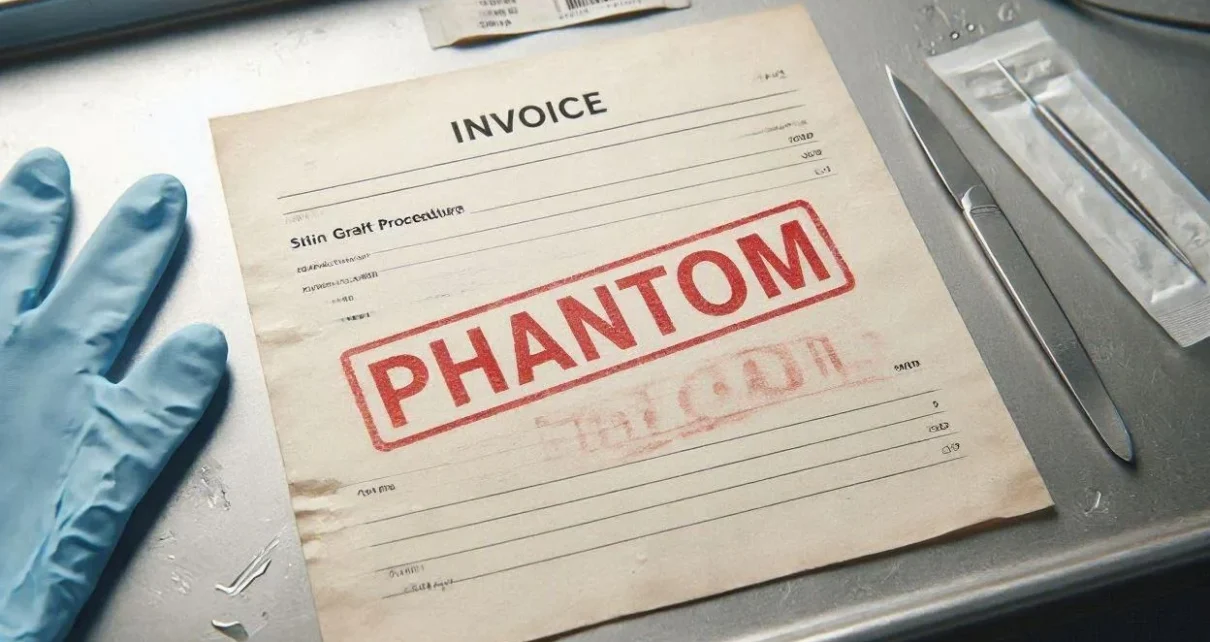
Prosecutors say some expensive skin grafts were billed but never applied to patients, creating a disputed paper trail in which medical records, product inventories, claim codes, patient accounts, and financial transactions could become decisive evidence.
WASHINGTON, DC, August 22, 2026 — Federal prosecutors investigating Florida nurse practitioner Leigh Tesar allege that Medicare received claims for costly wound allograft applications that never happened, introducing a stark “phantom procedure” theory into an already expansive health care fraud prosecution.
The allegation differs fundamentally from a dispute over whether a real treatment was medically necessary, because the government contends that some records and claims represented physical applications of skin substitutes even though prosecutors say no corresponding procedures were performed.
During an approximately eighteen-month period spanning May 2024 through November 2025, prosecutors say Tesar and others caused more than $118 million in wound-care claims, while Medicare allegedly paid Tesar and her Primecare business more than $61 million.
Tesar faces five health care fraud counts, one conspiracy count, and two counts alleging payment of health care kickbacks, while registered nurses Walter Presha Junior and Koby Evans face conspiracy and separate accusations that they received prohibited referral payments.
Every accusation remains unproven, the indictment itself is not trial evidence, and each defendant retains the presumption of innocence unless federal prosecutors establish every required element through admissible evidence beyond a reasonable doubt.
What Prosecutors Mean by a “Phantom” Procedure
The word “phantom” does not appear as a separately defined offense in the indictment, but it accurately describes the government’s allegation that a reimbursement request documented a medical event existing on paper without a matching procedure performed on the patient.
According to the federal indictment filed in the Middle District of Florida, Tesar and others allegedly submitted claims for purported allograft applications that were never rendered and falsified records by stating that specific treatments occurred when none were provided.
Those paired allegations give prosecutors two potential documentary layers to examine, because an allegedly false clinical entry could help support an allegedly false claim, while billing data could reveal the price, code, date, patient, provider, and payment associated with that entry.
The government has not publicly identified which particular applications within the overall claims population were allegedly nonexistent, and the five representative fraud counts do not expressly classify each listed transaction as unnecessary, unperformed, ineligible, misrepresented, kickback-tainted, or some combination.
That distinction matters because responsible reporting cannot assume that every claim, every graft, or every beneficiary mentioned in the indictment belongs to the phantom-procedure category when the charging document presents several overlapping theories of alleged fraud.
How an Allograft Application Becomes a Medicare Claim
Medicare Part B covers qualifying items and services provided by physicians, nurse practitioners, group practices, and other authorized professionals, but payment depends upon accurate documentation showing that care was medically reasonable, necessary, eligible, and delivered as represented.
The allografts described by prosecutors include certain bioengineered skin substitutes made from human placental tissue, which clinicians can place over qualifying open wounds to promote closure or skin growth when documented conditions support their use.
A legitimate claim ordinarily connects a named beneficiary, treatment date, billing code, described item or service, and rendering or ordering provider, creating an administrative representation that a particular medical event occurred for a particular person at a particular time.
Florida claims were processed through a Medicare administrative contractor acting for the Centers for Medicare and Medicaid Services, meaning payment decisions generally depended upon submitted codes and supporting records rather than direct observation of every bedside procedure.
That reimbursement structure makes contemporaneous documentation essential because a contractor cannot physically watch each graft application and must instead rely on a connected record of clinical findings, product use, practitioner activity, wound measurements, and coverage compliance.
When prosecutors allege a phantom procedure, they are effectively challenging the factual foundation beneath that chain, asserting that the claimed application was not merely questionable or poorly documented but absent from the patient’s actual care.
Physical Evidence Can Test Whether Treatment Occurred
Investigators examining whether a graft was applied can compare purchase orders, shipping confirmations, lot identifiers, product dimensions, storage records, inventory movements, treatment notes, wound photographs, application logs, schedules, and claims submitted for the same date.
No single missing document necessarily proves that a procedure never happened, because recordkeeping can be incomplete and clinical operations can be disorganized, but multiple unexplained contradictions may allow prosecutors to build a cumulative circumstantial case.
Product reconciliation could become especially important because expensive allografts are tangible materials that must ordinarily be ordered, received, stored appropriately, assigned to a patient, removed from inventory, prepared, and documented when used or discarded.
If claims data show more product applied than a practice purchased or received, investigators may argue that the arithmetic exposes impossible utilization, while defense lawyers may examine delayed invoices, transferred inventory, replacement shipments, wastage, returns, or recording errors.
Electronic health records may preserve authorship, creation times, modifications, copied language, template use, and late entries, enabling both sides to test whether treatment notes were contemporaneous or reconstructed after billing questions, audits, or investigative scrutiny emerged.
Patient and caregiver testimony can also be powerful, particularly when people remember whether a practitioner visited, whether a wound was uncovered and treated, whether packaged graft material appeared, and whether post-application instructions or dressings were provided.
Memories involving medically fragile beneficiaries must still be evaluated carefully, because illness, medication, age, repeated appointments, changing caregivers, and the passage of time can complicate recollection without automatically making a witness either reliable or unreliable.
A Phantom Claim Is Different from an Unnecessary Claim
An unnecessary procedure may have occurred physically but allegedly lacked sufficient clinical justification, whereas a phantom procedure allegedly never occurred at all, creating separate factual questions even when both theories appear within the same reimbursement investigation.
The indictment additionally alleges applications without adequate conservative care, applications placed on infected wounds, continued use after wounds stopped responding, and treatment of wounds that allegedly could not heal because patients were terminally ill.
Those medical-necessity theories will likely require detailed expert review of diagnoses, infection status, ulcer type, wound progression, previous treatment, underlying conditions, prognosis, and applicable coverage guidance across specific episodes of individual patient care.
By contrast, an allegation that no application occurred can rely more directly upon objective chronology and corroboration, including whether the practitioner appeared, whether product existed, whether records align, and whether the beneficiary or another caregiver observed treatment.
Prosecutors may nevertheless combine both approaches, arguing that a practice allegedly willing to document nonexistent care also had financial motives to continue unnecessary applications, while defendants may insist that distinct claims and patients cannot be merged into one generalized narrative.
Medical Records Are Central to the Alleged Billing Engine
Prosecutors accuse Tesar and others of altering the clinical story so allograft use appeared reasonable and compliant, including statements that earlier conservative treatments occurred, wounds were documented sooner, and patient conditions supported applications.
The filing further alleges that some charts falsely represented Tesar as personally administering prior conservative wound care, an assertion investigator could test against schedules, travel records, other providers’ notes, patient accounts, and the timing of electronic entries.
False dating would be especially relevant when coverage requires a documented period of unsuccessful conservative care, because moving a wound’s onset backward could create the appearance that necessary waiting and treatment requirements had already been satisfied.
Templates and copied notes can complicate authorship questions, however, since an inaccurate entry may originate with clerical staff, billing personnel, imported data, automatic software, or another clinician rather than the practitioner whose name appears on the claim.
Criminal liability therefore requires more than identifying a wrong chart entry, because prosecutors must connect material falsity with knowledge and intent while the defense can explore delegation, reliance, correction practices, software limitations, and ordinary administrative mistakes.
Five Representative Claims Illustrate the Financial Scale
Counts One through Five identify five separate beneficiaries through initials and list services between October 2024 and August 2025, with individual billed amounts ranging from approximately $288,350 to more than $1.11 million for wound care.
The corresponding Medicare payments ranged from roughly $199,769 to about $854,311, producing approximately $3.96 million billed and $2.82 million paid across the five transactions prosecutors selected as alleged executions of the broader scheme.
Those totals show why a single disputed application can carry extraordinary financial significance, particularly when a skin substitute is priced by square centimeter, and the treated wound area or selected product can sharply affect reimbursement.
The indictment does not specify within its count table whether any one representative claim concerns a wholly unperformed application, so assigning the phantom label to a particular beneficiary or dollar amount would exceed the public charging document.
At trial, prosecutors would need to connect each charged execution with the evidence supporting its alleged falsity, while jurors would evaluate the five counts individually even if broader pattern evidence is admitted for a permissible purpose.
Referral Payments Allegedly Expanded the Patient Pipeline
The phantom-procedure allegations operate within a wider claimed arrangement in which Presha, Evans, and other purported representatives allegedly identified Medicare beneficiaries with wounds and directed them to Tesar through sales agreements prosecutors describe as shams.
Prosecutors say the purported representatives were compensated through a Pennsylvania wound-product distributor identified as Company-I, connecting patient sourcing, graft purchases, Primecare payments, product assignments, and alleged referral commissions within a coordinated financial circuit.
One exchange described in the indictment allegedly calculated Presha’s expected compensation as twenty percent of invoices exceeding $4.06 million, while another communication allegedly emphasized that Evans already knew several patients who could begin treatment promptly.
Other messages allegedly compared products costing $2,000 and $1,591 per square centimeter and discussed switching patients to the more expensive option, communications prosecutors may use to argue that price, rather than clinical benefit, influenced selection.
In August 2025, Company-I allegedly transferred approximately $397,570 into an account associated with Presha and about $10,998 into an account associated with Evans, transactions underlying the federal indictment’s separate kickback-payment and kickback-receipt counts.
Presha and Evans may contend that their agreements reflected legitimate commercial services and that compensation was unrelated to prohibited referrals, while Tesar may dispute control, purpose, knowledge, or the government’s interpretation of communications and distributor payments.
Why Patient-Level Proof Will Matter
A large statistical anomaly can prompt scrutiny, but proving a phantom medical service ordinarily requires investigators to return from aggregate data to the individual beneficiary, reconstructing what happened before, during, and after the claimed treatment date.
For each disputed application, investigators may compare the wound’s documented location and dimensions with photographs, clinician notes, facility logs, caregiver observations, supply usage, follow-up instructions, claim submissions, and subsequent entries describing healing or deterioration.
Contradictory records could be particularly significant when one document describes an application while another places the patient elsewhere, identifies a different caregiver, shows no delivered product, or records a wound condition inconsistent with the billed service.
The defense can challenge that reconstruction by demonstrating missing records, incomplete investigative collection, inconsistent memories, lawful late documentation, product substitutions, shared inventory, or complex clinical workflows that prosecutors misunderstood when constructing their evidentiary timeline.
Independent experts may also distinguish between applying a billable skin substitute and using ordinary wound dressings, because patients or family members might remember a wound being treated without knowing exactly which material was used.
Beneficiaries Can Be Harmed Without Receiving a Procedure
A phantom claim can affect a beneficiary even when no graft touches the person, because false billing may enter claims history, consume program resources, trigger confusing notices, distort later medical review, or create questions about services the patient never remembers receiving.
The alleged conduct also risks weakening trust between vulnerable patients and legitimate wound-care professionals, particularly when beneficiaries depend upon nurses and practitioners to explain complex products, coverage rules, expected healing, and substantial financial consequences.
Prosecutors further allege that patients were encouraged to begin or continue treatment through misrepresented costs, unlawful copayment waivers, free medical supplies, jewelry, and a leather recliner, although those accusations remain subject to proof and defense challenges.
Patients reviewing Medicare statements can compare listed dates and services with personal calendars, caregiver notes, facility records, and treatment memories, then ask the provider or Medicare about entries that appear unfamiliar or materially inaccurate.
No beneficiary should discontinue necessary wound care solely because another practitioner has been indicted, and concerns about treatment should be discussed with an independent qualified clinician who can evaluate the wound, infection risk, progress, and appropriate alternatives.
The Government Must Prove Knowledge and Intent
Health care fraud requires more than a billing discrepancy, because prosecutors must establish that Tesar knowingly and willfully executed or attempted to execute a scheme involving materially false or fraudulent representations connected with a health care benefit program.
An omitted note, mistaken code, failed upload, mislabeled product, or misunderstood staff entry could produce an inaccurate claim without demonstrating a criminal scheme, making evidence of repeated conduct, concealment, communications, and financial benefit potentially important.
The government may argue that allegedly falsified charts, impossible product reconciliation, beneficiary testimony, electronic timestamps, and money flows reinforce one another, while the defense may challenge every link and offer innocent explanations for apparent inconsistencies.
Prosecutors also allege that Tesar removed her name from Primecare’s Florida ownership records following a Medicare audit while secretly retaining ownership and managerial control, conduct they characterize as an effort to evade continuing scrutiny.
The defense may offer a legitimate corporate or regulatory explanation for that filing change and argue that ownership paperwork cannot prove whether any specific procedure happened, any chart was knowingly falsified, or any claim carried fraudulent intent.
Local Reporting and the National Enforcement Context
Independent WWSB reporting on the Tesar indictment summarized the government’s allegation that some allografts were never applied, along with accusations of unnecessary treatment, infected wounds, kickbacks, approximately $61 million in payments, and $11.8 million in seized assets.
The case emerged from the Justice Department’s 2026 National Health Care Fraud Takedown, which announced charges against 455 defendants across fifty-six federal districts involving more than $6.5 billion in alleged false claims and significant patient harm.
Federal officials said the wider operation involved ninety doctors and other licensed medical professionals and produced seizures exceeding $182 million, reflecting an enforcement strategy that combines claims analytics, traditional investigation, financial tracing, and coordinated prosecutions.
Wound-care cases received exceptional attention because high prices per square centimeter can produce enormous reimbursements, while fragmented relationships among manufacturers, distributors, marketers, clinicians, facilities, and billers can make responsibility difficult to identify without integrated records.
Forfeiture Raises the Financial Consequences
The indictment seeks approximately $61.63 million from Tesar, about $3.19 million from Presha, and roughly $263,223 from Evans through criminal forfeiture allegations tied to property prosecutors contend represents proceeds traceable to charged conduct.
Authorities have identified approximately $11.8 million already seized from financial accounts associated with the case, but pretrial restraint does not establish guilt, lawful ownership, traceability, valuation, or the government’s ultimate entitlement to permanent forfeiture.
Prosecutors additionally allege that scheme proceeds financed more than $215,000 in Tampa Bay Buccaneers tickets and a luxury stadium suite, together with more than $400,000 spent purchasing fine art for their personal enjoyment.
Luxury spending can strengthen a memorable prosecution narrative, but it cannot establish that a medical application was fictitious; the government must prove underlying offenses and connect disputed property to criminal proceeds under applicable forfeiture rules.
Compliance Controls That Can Expose Phantom Billing
Wound-care organizations can reduce phantom-procedure risk by reconciling purchased inventory with patient-level usage, recording product lot numbers and dimensions, preserving dated photographs, documenting wastage, and separating clinical entries from billing approval whenever operationally possible.
Supervisors should compare practitioner schedules, facility access logs, shipment records, electronic entry timestamps, and claims volume, particularly when one provider appears to perform unusually large numbers of high-value applications across distant locations or compressed periods.
Independent audits should sample individual claims from beginning to end, confirming that the beneficiary existed, the visit occurred, the product was available, the wound qualified, the application happened, the chart matched reality, and billing reflected delivered care.
Organizations should also review referral contracts, percentage-based compensation, product switching, routine copayment waivers, beneficiary gifts, post-audit ownership changes, and unexplained chart modifications, because those facts can transform isolated discrepancies into a broader compliance concern.
Whistleblower reporting channels must protect employees who identify impossible schedules, missing inventory, cloned notes, unfamiliar beneficiaries, or pressure to submit claims before documentation is complete, while investigations should remain fair and preserve evidence objectively.
Public Allegations Create Immediate Reputation Risk
Major federal indictments can quickly appear in search results, licensing reviews, payer audits, banking compliance systems, employer decisions, and international due-diligence databases, creating significant consequences before a court determines whether the accusations are accurate or legally sufficient.
The Amicus International Consulting news and analysis hub follows health care fraud, asset seizure, identity, extradition, and cross-border enforcement matters while maintaining the essential distinction among allegations, convictions, guilty pleas, civil settlements, and unresolved proceedings.
Professionals and organizations facing intense scrutiny may also consult Amicus International Consulting’s crisis communications and reputation-management guidance, which emphasizes disciplined factual review, coordinated stakeholder messaging, careful media preparation, and respect for active investigations or litigation.
Responsible communication must never conceal evidence, pressure beneficiaries, coordinate false accounts, influence witnesses, or obstruct investigators, but accurate procedural context can prevent an indictment from being reported as a conviction and preserve fairness during public scrutiny.
What Happens Next in the Leigh Tesar Case
The litigation may proceed through extensive discovery, motions, expert analysis, forfeiture disputes, plea negotiations, or trial, with prosecutors expected to assemble clinical, digital, physical, financial, and testimonial evidence around particular beneficiaries and treatment dates.
Medical experts may address whether real applications were appropriate, reimbursement specialists may explain what each claim represented, and forensic accountants may trace money among Primecare, Company-I, related businesses, investment accounts, and alleged personal expenditures.
For the phantom-procedure theory, however, the central question remains unusually concrete: whether expensive skin substitutes represented to Medicare as applied to identified patients were physically used as claimed, or existed only within records and reimbursement requests.
Prosecutors will attempt to prove that allegedly false charts, product evidence, beneficiary accounts, claim data, referral payments, and concealment form a deliberate system, while defense lawyers will seek to separate errors, ambiguities, lawful care, and legitimate compensation.
Until evidence is tested and a plea, verdict, dismissal, or other judicial resolution establishes the outcome, the Leigh Tesar case remains a serious but unproven accusation that Medicare paid for wound-care applications prosecutors say never occurred.