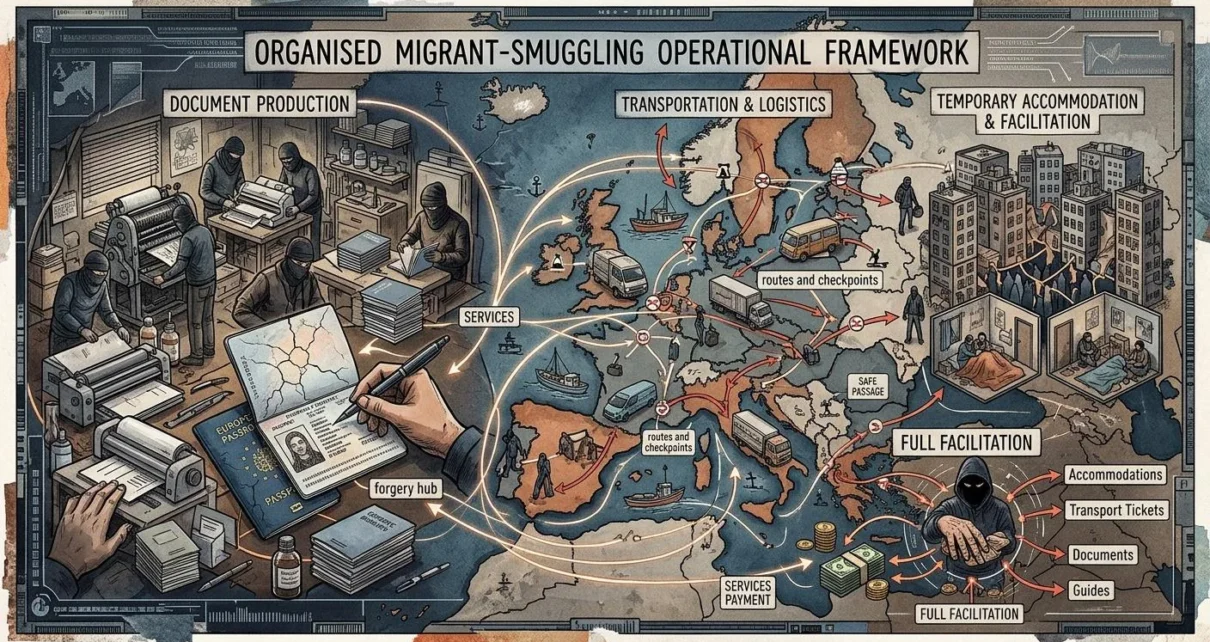
Europol investigations reveal how forged passports, fraudulent residence permits, and counterfeit identity cards support criminal networks that provide transportation, accommodation, and identity concealment across international borders.
WASHINGTON, DC, November 11, 2026 — Counterfeit passports and fraudulent identification documents remain important components of organized migrant-smuggling operations across Europe, where criminal networks have combined document production with transportation arrangements, temporary accommodation and other services intended to facilitate unauthorized international movement.
Recent investigations involving Greece, Austria, Spain and several other European countries demonstrate that forged credentials are not always isolated products, but can form part of larger criminal enterprises whose organizers coordinate movement, collect payments and distribute identification through international networks.
Europol’s investigations have identified suspected criminal groups operating document-production facilities, recruiting customers through intermediaries and arranging travel through airports, while separate enforcement actions have uncovered financial activity and logistical services connected with irregular migration.
The findings underscore why investigators increasingly examine the relationships among suspected document suppliers, smugglers and financial facilitators, while distinguishing criminal organizers from migrants whose circumstances may involve deception, coercion or other forms of vulnerability.
Greece Becomes a Major Focus of Document-Forgery Investigations
Greek law enforcement authorities have repeatedly uncovered suspected criminal groups manufacturing counterfeit passports, national identity cards, visas and residence permits, with Europol providing analytical and operational assistance during investigations involving international migrant movement.
In March 2024, Europol announced that Greek authorities had dismantled four document-production facilities and arrested 11 people during coordinated enforcement actions conducted between September 2023 and February 2024.
The operation resulted in the seizure of 4,650 fraudulent documents, specialized printing equipment and more than 20,000 euros in cash, while investigators identified over 50 suspected migrant-smuggling cases involving international air travel.
Authorities said the suspected organization supplied counterfeit credentials resembling documents from several European countries, illustrating how one criminal network could serve customers seeking to travel through different jurisdictions using misleading identity information.
Athens Forgery Network Offered Broader Smuggling Services
Investigators found that the Greek operation went beyond selling fraudulent documents, with suspects allegedly arranging airline travel and supplying counterfeit identification to facilitate unauthorized journeys between Greece and other European destinations.
Europol reported that individual false documents were priced between 400 and 1,200 euros, while complete suspected air-smuggling arrangements involving fraudulent credentials and airline tickets could cost approximately 6,000 euros per person.
Those figures provide evidence of the commercial relationships alleged in this investigation, but they should not be presented as standard prices across Europe’s illegal migration market or as proof of successfully completed journeys.
The operation showed how document production can integrate with transportation services, allowing suspected criminal participants to profit from several related activities while raising additional investigative questions about individual roles and responsibility.
Greek Authorities Uncover Another Network in 2025
A separate Greek investigation announced in May 2025 revealed an alleged organized operation combining counterfeit travel documents with migrant transportation, temporary accommodation and logistical arrangements involving travel by air, land and sea.
As Kathimerini reported on May 24, 2025, Greek authorities arrested 23 suspects and identified 26 additional individuals being sought in connection with an organization allegedly active since early 2024.
Investigators reported recovering more than 4,100 fraudulent identification documents, including passports, identity cards, and residence permits, and estimated that the wider criminal activities generated more than 3 million euros in proceeds.
The network allegedly provided temporary accommodation and coordinated journeys to European destinations, demonstrating why investigators must examine housing arrangements, transportation and financial transactions alongside the counterfeit documents recovered during enforcement operations.
Document Suppliers Can Operate as Separate Criminal Businesses
Europol has described document-forgery groups as specialized suppliers that may support several migrant-smuggling organizations, allowing criminal intermediaries to acquire fraudulent credentials without necessarily maintaining their own manufacturing capabilities or document-production facilities.
In the 2024 Greek investigation, authorities reported that suspected forgers operated separate printing facilities but sometimes cooperated with one another, while intermediaries managed customer relationships and delivered counterfeit documents.
This organizational distinction matters because dismantling a suspected manufacturing operation may disrupt several criminal relationships, whereas arresting someone carrying fraudulent identification does not necessarily establish who created or distributed that credential.
For investigators, identifying suppliers and intermediaries requires corroborated evidence linking particular individuals to suspected criminal transactions, rather than assuming that everyone associated with a counterfeit document knowingly participated in organized smuggling.
European Airports Become Part of Forgery Investigations
An international operation announced in September 2026 further illustrated the connections between fraudulent identification and migrant smuggling, with Europol describing a network allegedly arranging air travel through Schengen-area airports toward the United Kingdom.
The investigation involved law enforcement agencies from 17 countries and resulted in six arrests and 10 searches across Austria, Italy, Spain and Britain, following inquiries into document supply, suspected money laundering and unauthorized border crossings.
Europol reported that many migrants initially entered the European Union using genuine passports and, in numerous cases, valid tourist visas, before allegedly receiving counterfeit identification to move under misleading personal details.
The findings demonstrate why authentic entry documents and fraudulent credentials must be examined separately, because a person may initially enter a country with legitimate identification before suspected criminal intermediaries become involved in later travel arrangements.
Spanish Document Distribution Reaches Several Continents
The September 2026 investigation identified a suspected cell in Spain linked to the distribution of more than 1,000 fraudulent identity documents, showing how document suppliers can reach customers well beyond the countries where associated smuggling investigations originate.
Authorities reported that documents were sent through international delivery channels from the United Arab Emirates to Europe, North America, South America, and the Caribbean, creating investigative challenges across multiple jurisdictions and legal systems.
A suspected cell operating around Vienna was linked to supplying fraudulent identification and allegedly using commercial businesses to conceal unlawful financial proceeds, underscoring the importance of examining potential financial relationships alongside document distribution.
Europol reported indications that the wider organization generated more than 2 million euros in illicit proceeds, though that amount referred to the suspected criminal enterprise as a whole rather than solely the sale of counterfeit passports.
Accommodation and Travel Arrangements Form Part of the Service
Migrant-smuggling investigations increasingly examine accommodation and travel arrangements because suspected criminal organizations may provide several connected services, including temporary lodging, transportation coordination and fraudulent documentation intended to support unauthorized movement.
These arrangements can create financial dependence among migrants who have paid substantial sums, particularly when individuals borrow money for a promised journey or rely on intermediaries who control transportation and access to accommodation.
However, a legitimate hotel booking, travel agency transaction or short-term rental should not be treated as evidence of smuggling without additional facts establishing a connection to criminal activity and the knowledge of relevant participants.
Investigators therefore need to distinguish ordinary commercial services from arrangements knowingly used to facilitate offenses, while considering whether migrants involved in a suspected operation experienced deception, exploitation or other circumstances requiring protection.
American Investigations Reveal Similar Document-Related Risks
Document fraud connected to international migration is not exclusively a European concern, as American federal prosecutors have investigated alleged operations involving fraudulent citizenship claims, misleading immigration documents and commercial arrangements supporting unauthorized entry.
In a federal case announced in 2025, prosecutors charged 12 individuals accused of participating in an international operation involving fraudulent travel authorizations, asylum-related deception, money laundering and the movement of Cuban nationals toward the United States.
According to the U.S. Department of Justice’s announcement of the international smuggling and fraud charges, investigators alleged that the organization submitted hundreds of fraudulent travel authorization applications while advertising its services through social media and electronic messaging platforms.
The allegations involved purported European citizenship, fabricated information and financial transactions associated with travel arrangements, demonstrating how identity deception can become integrated into a larger commercial operation without requiring every offense to involve a physically counterfeit passport.
Digital Advertising Connects Migrants With Criminal Intermediaries
Online advertisements and messaging services can create opportunities for suspected migrant smugglers to reach customers across national borders, particularly when individuals searching for transportation or immigration assistance encounter deceptive claims concerning official documentation.
International investigators have identified examples of online communications offering travel arrangements and fraudulent identification, making electronic evidence relevant to understanding suspected criminal relationships while requiring appropriate legal authorization and corroboration.
Digital communications can also involve scams or misleading promises that never produce usable documents, so authorities must distinguish advertised services from verified criminal transactions and avoid assuming every online inquiry establishes intentional participation.
The use of electronic platforms expands the investigative environment beyond physical production facilities, linking potential evidence involving customer contact, financial records and communications with the counterfeit materials discovered during separate enforcement actions.
Modern Passport Security Creates Obstacles for Counterfeiters
Governments continue strengthening passport designs through specialized identity pages, laser engraving, optical security features, and electronic authentication, giving trained inspectors several ways to determine whether a questioned credential matches an authentic government-issued document.
As Amicus International Consulting explains in its analysis of modern passport security and counterfeit detection, physical document examination, electronic chip authentication, and biometric identity comparison address separate security questions that become more useful when considered together.
Electronic passports can contain digitally signed identity information that compatible inspection equipment authenticates using trusted issuing-authority certificates, helping establish whether protected data originated from a recognized government and remained unchanged after personalization.
These safeguards do not independently establish that a genuine passport belongs to its presenter or was lawfully obtained, so authorities must perform additional identity verification when they suspect impersonation or inconsistent government records.
Biometric Screening Supports Identity Verification
Facial recognition and other authorized biometric comparisons can help border authorities determine whether a traveler matches a trusted reference image, potentially identifying cases where someone presents authentic documents improperly.
However, biometric verification cannot establish every aspect of immigration eligibility or criminal conduct, and uncertain comparisons may require trained human review when image quality, appearance changes or technical conditions affect results.
Suspected smuggling networks that use fraudulent documents therefore require a broader investigative approach, combining identity authentication with evidence on transportation arrangements, financial transactions, and the circumstances surrounding the individual’s journey.
Human Smuggling and Human Trafficking Require Different Assessments
Human smuggling generally involves facilitating unlawful entry across international borders, while human trafficking involves exploitation through legally defined forms of coercion, fraud or other prohibited conduct and does not necessarily require international transportation.
The distinction is essential because a migrant traveling with fraudulent identification may have knowingly purchased an illegal service, received documents through deception or experienced coercion by individuals controlling movement and personal information.
Law enforcement agencies must therefore assess the circumstances of suspected victims separately from those of criminal organizers, recognizing that possession of a counterfeit credential does not, by itself, establish participation in document production or distribution.
This approach strengthens investigations by identifying potential exploitation while allowing prosecutors to pursue individuals whose criminal responsibility is supported by reliable evidence of smuggling, document fraud or related offenses.
Financial Investigations Help Expose Organized Smuggling
Financial evidence can be important when investigators seek to understand how suspected smuggling organizations receive payments, distribute proceeds, and support operations involving fraudulent identification, transportation services, or temporary accommodation.
The September 2026 Europol investigation demonstrated this connection by identifying suspected financial activity linked to document distribution, while the Greek operations revealed commercial arrangements that extended beyond manufacturing individual counterfeit credentials.
Authorities must still establish that relevant transactions correspond to suspected criminal activity, since ordinary payments for transportation or accommodation do not, on their own, prove that a business or individual knowingly supported migrant smuggling.
Appropriate financial investigation can help identify suspected organizers and distinguish commercial intermediaries from unrelated businesses, particularly when activities cross jurisdictions governed by different evidentiary requirements and privacy protections.
International Cooperation Connects Separate Investigations
Counterfeit identity documents recovered in different countries may initially appear unrelated, making international information sharing important when authorities seek to determine whether suspicious credentials originated from common suppliers or connected criminal operations.
Europol’s investigations show how coordination among national agencies can help establish links among suspected manufacturing facilities, financial intermediaries, and distribution networks, while maintaining the separate responsibilities of participating police and judicial authorities.
The effectiveness of such cooperation depends on accurate records, lawful evidence exchange and reliable forensic examination, ensuring that apparent similarities between documents are evaluated carefully rather than treated as automatic proof of shared criminal origins.
Border Security Requires More Than Document Seizures
Confiscating counterfeit passports can interrupt a particular journey or financial transaction, but it does not necessarily eliminate the underlying criminal organizations supplying fraudulent credentials or arranging unauthorized movement across international borders.
Investigators increasingly need to examine suspected suppliers, commercial relationships and logistical arrangements while preserving safeguards for legitimate travelers and people who may have experienced deception or exploitation during their journeys.
The Greek investigations demonstrate this broader approach through coordinated examinations of document factories, alleged transportation arrangements and temporary accommodation, revealing why criminal enterprises cannot always be understood through the documents recovered during individual encounters.
The Future of Enforcement Depends on Network Investigations
The continuing overlap between counterfeit documents and migrant smuggling shows why governments must combine reliable passport authentication with criminal investigations that can identify organizers, financial relationships, and suspected distribution activity across jurisdictions.
Modern security technology can strengthen detection, but effective enforcement also depends on accurate government records, cooperation among international agencies and appropriate assessment of migrants whose circumstances may involve exploitation rather than deliberate criminal participation.
Ultimately, the European investigations show that fraudulent travel documents often function within a larger criminal service, making coordinated investigations and evidence-based enforcement essential to disrupting suspected smuggling networks while protecting legitimate international mobility.