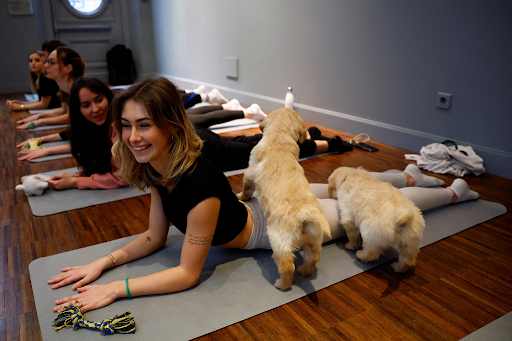
On the surface, puppy pilates sounds like something designed purely for social media — adorable puppies wandering across yoga mats while people try to hold a plank, everyone laughing, everyone leaving with about forty new photos on their phone. And yes, that part is real. But dismissing puppy pilates as nothing more than a novelty undersells what’s actually happening in these classes and why the people who attend them keep coming back.
The combination of structured physical movement with animal interaction isn’t accidental, and the wellness outcomes it produces aren’t superficial. There’s a real body of research on both sides of this equation — on the benefits of Pilates as a movement practice and on the measurable physiological effects of interacting with animals — and when you put them together in a single 75-minute experience, the result is something that a regular fitness class or a regular trip to the dog park independently can’t replicate.
What Pilates Actually Does — and Why the Format Matters
Pilates is a low-impact movement system built around core strengthening, postural alignment, spinal mobility, and controlled breathing. Unlike high-intensity training that produces stress hormones as a byproduct of physical exertion, Pilates is designed to activate the parasympathetic nervous system — the part of your physiology responsible for rest, recovery, and calm. The controlled, intentional nature of the movements, combined with the breathing patterns built into Pilates practice, creates a physical experience that is simultaneously challenging and genuinely calming.
This is the reason Pilates attracts people who are looking for something that feels good to do rather than something to survive. It builds real functional strength — particularly in the deep stabilizing muscles of the core, hip, and shoulder girdle that most gym-based training neglects — while producing a post-workout feeling that’s more similar to having had a massage than having run a sprint interval session. For people managing chronic stress, recovering from injury, or simply looking for a movement practice that they can sustain long-term without dreading, mat Pilates consistently delivers.
The 45-minute mat Pilates component of a Puppies & Pilates class is a real workout led by qualified instructors. It’s not a warm-up for the puppy portion — it’s a complete session that produces the physical benefits that Pilates is known for.
What Happens to Your Body When You Interact With Puppies
The physiological response to interacting with dogs — particularly young puppies — is well-documented and significant. Contact with dogs triggers the release of oxytocin, the same bonding hormone involved in human social connection. Simultaneously, it reduces cortisol levels — the primary stress hormone — in both the person and the animal. Blood pressure and heart rate typically decrease during sustained animal interaction, effects measurable enough that animal-assisted therapy programs have built entire clinical applications around them.
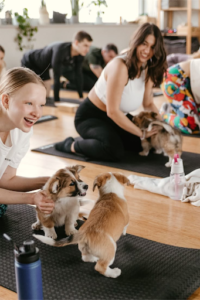
The puppy interaction component of a Puppies & Pilates class isn’t passive. The 30 minutes of puppy time following the Pilates session involves genuine, unstructured interaction — puppies in the 7-to-12-week age range are at the developmental stage where human contact is most impactful for their socialization, and they engage actively with the people in the room. The oxytocin response this produces is real, measurable, and immediate. Most people describe the feeling of leaving a puppy pilates class as something like having been simultaneously physically worked out and genuinely emotionally reset — which is a combination that almost no other wellness experience offers.
The puppies who participate in each class are carefully selected and cared for — fully weaned, up to date on vaccinations, and evaluated individually before joining a session. Each puppy in the class has access to fresh water throughout, enjoys substantial rest time between sessions, and participates in a deliberately low-stress environment designed as much around their wellbeing as around the participants’ experience. The result is puppies that are genuinely comfortable and engaged — which is what makes the interaction feel natural rather than forced.
The Social Dimension That Fitness Classes Usually Miss
Regular fitness classes create a shared physical experience, but they don’t necessarily create connection. People in a spin class or a HIIT session are focused on their own performance — on the metrics, on getting through it, on not slowing down the group. There’s camaraderie in that, but it’s incidental to the primary activity.
A puppy pilates class creates a different social environment. The puppies are a shared focal point that naturally breaks down the social barriers that fitness settings sometimes amplify. People who wouldn’t typically talk to each other in a gym are talking because a puppy has just climbed onto someone’s mat and made the whole room laugh. The curated mocktail moment at the end of each session — a detail that reflects the genuinely premium approach to the experience — gives participants a structured opportunity to decompress together rather than rushing for the exit.
For people who’ve been feeling socially isolated, who are new to a city, or who are simply looking for a wellness activity that they can do with a friend and actually enjoy talking about afterward, puppy pilates delivers something that goes beyond the physical workout. It creates the kind of shared experience that becomes a story people tell — and the kind of thing people want to book again as soon as the next class opens.
Why Spots Fill as Fast as They Do
The waitlist reality for Puppies & Pilates classes isn’t manufactured scarcity — it reflects a genuine capacity constraint built around the puppies’ wellbeing. Class sizes are limited to ensure that each puppy has manageable, positive interactions rather than being overwhelmed by too many people at once. The puppy interaction time is capped at the session length to protect their rest schedules. These aren’t arbitrary limits; they’re the reason the experience feels the way it does rather than chaotic.
For anyone who’s been curious about trying a class, the practical reality is that waiting until you’re ready to decide usually means waiting weeks longer than you need to. Signing up first and deciding the timing is right is almost always the better approach for a format where availability genuinely depends on puppy schedules that can shift.


