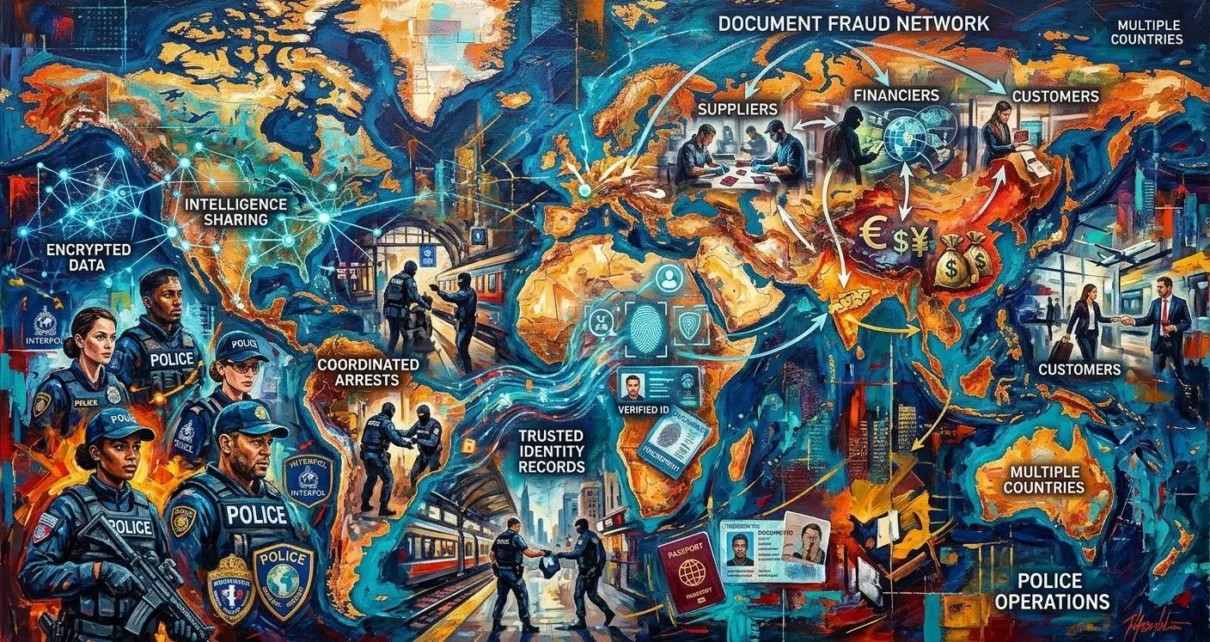
International police operations show how intelligence sharing, coordinated arrests, and trusted identity records help investigators pursue document fraud networks whose suppliers, financiers, and customers operate across multiple countries.
WASHINGTON, DC, November 13, 2026 — International investigators are confronting counterfeit passport networks that cross national borders, connect suspected document suppliers with migrant smugglers and exploit differences among legal systems, making cooperation among police, prosecutors and border authorities increasingly important to disrupting criminal operations.
The challenge extends beyond intercepting an individual forged passport because suspects involved in production, distribution, financing and misuse may operate in separate jurisdictions, leaving investigators to connect evidence that no single national agency can independently assemble, including records supplied by banks, transportation companies and foreign investigators whose powers, documentation standards and disclosure obligations may differ substantially across jurisdictions.
Recent coordinated operations across Europe, Africa and the Middle East demonstrate how joint enforcement can reveal suspected criminal relationships, while also illustrating the limits of statistics that combine document offenses with other serious crimes.
International Operation Demonstrates the Value of Coordinated Enforcement
INTERPOL announced Nov. 10 that Operation Communis Maris, conducted Oct. 5-8, produced 262 arrests and opened 434 investigations involving suspected smuggling and related offenses across the Mediterranean and West African Atlantic migration routes.
Authorities from 16 countries participated with support from Europol, Frontex and other international organizations, identifying 41 organized criminal groups and 109 potential trafficking victims while examining suspected offenses that included fraudulent document production and use.
The operation involved more than 7,600 officers and hundreds of thousands of identity checks, with an Athens coordination unit supporting timely intelligence exchanges among participating teams rather than leaving each national authority to interpret discoveries alone.
Those arrests were not exclusively passport fraud cases, and the distinctions matter because 221 individuals were accused of migrant smuggling, 16 of trafficking and 25 of other offenses, including document-related conduct, particularly when relevant evidence spans multiple national jurisdictions.
Cross-Border Intelligence Helps Connect Separate Document Seizures
A forged identification document recovered at one airport may initially appear unrelated to another suspicious credential examined elsewhere, particularly when the documents carry different personal details and emerge during separate national investigations, while investigators maintain appropriate safeguards for individual rights.
Sharing reliable forensic observations and relevant case information can help investigators determine whether similarities warrant further inquiry into common suppliers, suspected intermediaries, or recurring patterns, without assuming that every comparable feature proves a connection.
The objective is not simply to collect more names but to establish trustworthy relationships among events, documents, and individuals through lawful exchanges that respect domestic procedures and avoid turning preliminary suspicion into an unsupported allegation.
Europol Case Reveals a Seventeen-Country Investigation
In September 2026, Europol described an investigation involving authorities from 17 countries that targeted a suspected criminal network accused of supplying fraudulent documents, laundering money and facilitating unauthorized air travel toward Britain, within the legal frameworks governing participating national authorities.
Coordinated action in Austria, Italy, Spain and Britain produced six arrests and 10 searches, while investigators identified alleged activities involving counterfeit identity distribution and suspected illegal proceeds exceeding 2 million euros, as investigators establish connections through independently corroborated evidence.
One suspected cell operated around Vienna, while another associated with Spain allegedly distributed more than 1,000 fake identity documents through international channels, showing why authorities needed evidence from several jurisdictions to understand the wider operation.
Europol said participants often entered the European Union using genuine passports before allegedly switching to counterfeit credentials, reminding investigators to distinguish fraudulent document use from the lawful possession of authentic travel papers.
American Agencies Participate in International Investigations
The United States appeared among the participating countries in the Europol-supported investigation, illustrating that a network centered on European routes can still require assistance or information from authorities beyond the locations where arrests occur.
Within the United States, federal agencies can coordinate international inquiries through established channels involving prosecutors, specialized investigative services and INTERPOL Washington, while the available legal authority determines which information may be shared, without treating preliminary investigative findings as criminal convictions.
Cross-border cooperation must also accommodate federal, state and local responsibilities because suspected passport fraud can surface during financial investigations, traffic encounters or other domestic inquiries far removed from an international airport, while maintaining reliable records and accountable investigative procedures.
U.S.-Dutch Cooperation Disrupted an Online Identity Market
An American investigation into VerifTools, an online marketplace accused of selling fraudulent identification, showed how criminal services that reach customers internationally can require coordinated action among investigators and prosecutors in different legal systems, where separate agencies may hold key evidence.
The U.S. Department of Justice’s August 2025 announcement described cooperation involving the FBI, American prosecutors, the Dutch National Police, and the Netherlands Public Prosecution Service, along with the seizure of marketplace domains associated with fraudulent passports and driver’s licenses.
Federal authorities identified about $6.4 million in illicit proceeds tied to the broader marketplace, though that figure should not be misrepresented as revenue from physical counterfeit passports alone or as evidence of successful border crossings.
The case demonstrates how international legal assistance can help disrupt digital services and preserve evidence, while reminding readers that electronic identification images differ substantially from government-issued travel booklets with authentic security features, as authorities distinguish legitimate travel from suspected criminal misconduct.
Aviation Partners Can Detect Problems Before Arrival
International airlines play an important role in travel-document screening because passengers typically present identification before boarding, creating opportunities to spot discrepancies before an individual reaches a destination country’s immigration counter, especially when evidence spans multiple jurisdictions.
U.S. Customs and Border Protection’s Carrier Liaison Program provides technical guidance and training on documentation requirements and suspected fraud and impostor identification, supports commercial carriers without transferring final immigration decisions from government officers, and maintains appropriate safeguards for individual rights.
Such cooperation requires practical communication because airline personnel encounter unfamiliar passport generations, emergency travel documents and rapidly changing entry requirements, making appropriate escalation procedures preferable to unsupported assumptions about a traveler’s identity, within the legal frameworks governing participating national authorities.
Live Intelligence Sharing Can Support Faster Decisions
During Operation Communis Maris, INTERPOL reported more than 210,000 queries against its databases, showing the role that accessible international records can play when officers examine travelers and investigate suspected criminal connections, as investigators establish connections through independently corroborated evidence.
A reliable database response may provide a lead concerning a reported lost document or other relevant record, but a technical match requires appropriate interpretation and does not automatically establish wrongdoing by the person presenting identification.
As AFP reported in its November 2026 coverage of the coordinated crackdown, the operation identified 41 suspected smuggling networks, underscoring the need to distinguish investigative findings from final criminal convictions.
Coordinated Searches Support Evidence Preservation
When suspected document suppliers and financial intermediaries operate across several countries, synchronized enforcement activity can reduce delays between investigative decisions and help preserve relevant evidence under the authority of participating jurisdictions, before important records become unavailable.
The Europol case illustrates this approach through searches in four countries, but each participating government remains responsible for applying applicable warrant requirements, detention rules and standards governing the admissibility of collected material, while maintaining reliable records and accountable investigative procedures.
Investigators must also document how they obtained and maintained electronic records, questioned passports, and other materials, because reliable evidence handling becomes especially important when prosecutors later present findings in different legal systems, where separate agencies may hold key evidence.
Passport Forensics Can Strengthen Shared Investigations
Modern passports incorporate specialized materials, machine-readable information, and electronic chips, giving properly equipped authorities multiple ways to examine whether a questioned document matches the genuine credential issued by its claimed government, as authorities distinguish legitimate travel from suspected criminal misconduct.
As explained in Amicus International Consulting’s passport-security analysis, physical security examination, electronic authentication and identity verification answer different questions, making combined interpretation more dependable than reliance on a single visible feature, particularly when relevant evidence spans multiple national jurisdictions.
When examiners identify suspicious characteristics, appropriately shared findings may help investigators assess whether separate cases deserve further comparison, although definitive conclusions require evidence and cannot rest on superficial resemblance alone, while investigators maintain appropriate safeguards for individual rights.
Electronic Authentication Depends on International Trust
Electronic passport validation relies on trusted issuing-authority information, allowing compatible inspection equipment to evaluate digitally signed chip data and determine whether protected information has been modified since legitimate personalization, subject to applicable international standards and national verification procedures.
International standards and certificate-sharing arrangements support interoperability, but authorities still need trustworthy records, appropriate equipment and trained personnel capable of understanding incomplete checks or technical problems during a routine inspection, particularly when authentic documents originate from unfamiliar issuing authorities.
An authentic chip signature does not establish that a passport was lawfully obtained or is presented by its rightful holder, reinforcing the importance of complementary identity checks and relevant document-status information, especially when authorities investigate possible impersonation.
Financial Cooperation Can Reveal Supporting Networks
Document fraud investigations may intersect with money laundering, recruitment payments and other transactions, making lawful financial information exchanges important when authorities seek evidence of suspected organizers and relationships spanning multiple jurisdictions, while maintaining reliable records and accountable investigative procedures.
The September Europol investigation included allegations of financial activities linked to suspected document supply, illustrating why investigators may need to compare evidence from banks, commercial records, and other sources under relevant legal safeguards.
A suspicious transaction alone does not prove criminal activity, and agencies must corroborate findings before attributing wrongdoing to individuals whose names appear in records linked to an investigated network, especially when separate agencies hold key evidence.
Trafficking Victims Require Separate Protection
International operations targeting smuggling may also identify potential trafficking victims whose circumstances involve deception, coercion or exploitation, requiring authorities to distinguish suspected criminal organizers from people needing protection and additional assistance through appropriate victim-support services.
Operation Communis Maris identified 109 potential trafficking victims, demonstrating how a coordinated enforcement effort can generate both criminal investigative leads and opportunities for authorities to recognize individuals facing serious risks, particularly when victims travel through multiple national jurisdictions.
A person carrying fraudulent identification may have received it through coercion or deception, so possession alone does not establish that the individual knowingly produced, purchased or distributed counterfeit documents, while investigators maintain appropriate safeguards for individual rights.
Cooperation Must Respect Different Legal Systems
International investigations confront differences in evidence standards, privacy protections, extradition rules and prosecutorial authority, meaning an operationally useful intelligence lead may require further legal steps before becoming admissible courtroom evidence, particularly when foreign records require judicial authorization.
Mutual legal assistance and other recognized procedures can help authorities lawfully secure relevant records, but effective cooperation depends on accurate requests, clear jurisdictional responsibilities, and careful protection of sensitive personal information, as investigators establish connections through independently corroborated evidence.
Agencies should also distinguish active investigations from convictions, because arrests and searches reported during multinational operations do not establish guilt and accused individuals retain the protections afforded by applicable law, regardless of the scale of an investigation.
Digital Markets Add Another International Dimension
Online vendors accused of selling fraudulent identification may advertise to international customers while their electronic infrastructure and financial records span multiple countries, making coordinated cybercrime inquiries especially important for establishing responsibility while maintaining reliable records and accountable investigative procedures.
The VerifTools case showed that marketplace disruption can require assistance beyond the country where investigators first discovered suspected offenses, including coordination with foreign law enforcement and prosecutorial authorities, where separate agencies may hold key evidence.
However, producing a convincing identity image does not mean a product is a functioning passport, and investigators must distinguish commercial verification fraud from counterfeit credentials intended for physical border inspection.
Consistent Reporting Helps Authorities Interpret Threats
Cross-border enforcement statistics require careful explanation because a joint operation may report arrests, document seizures, database queries and new investigations as different categories that cannot simply be added together to estimate offenders, particularly when reported categories overlap.
Reported increases in detected fraud can reflect changing enforcement intensity or improved screening rather than a demonstrated increase in underlying criminal activity, making comparable definitions and transparent methodologies essential to responsible analysis, particularly when relevant evidence spans multiple national jurisdictions.
The same caution applies to immigration cases because an irregular journey does not necessarily involve a counterfeit passport, and a forged document does not independently establish trafficking, terrorism or organized criminal membership, while investigators maintain appropriate safeguards for individual rights.
International Cooperation Strengthens Long-Term Border Security
The strongest international approach connects secure passport issuance, credible document verification, trained border officers, and lawful intelligence exchange, helping participating agencies recognize suspicious activity without creating unnecessary obstacles for legitimate travelers, within the legal frameworks governing participating national authorities.
Authorities also need mechanisms to resolve erroneous records and protect individuals whose identities were stolen, since stronger information sharing must not amplify mistakes across multiple national databases or criminal investigations, as investigators establish connections through independently corroborated evidence.
Ultimately, the continuing threat of document fraud shows why governments need enduring operational relationships rather than occasional coordinated arrests, with effective cooperation grounded in trustworthy evidence, appropriate safeguards and shared responsibility for protecting international mobility.