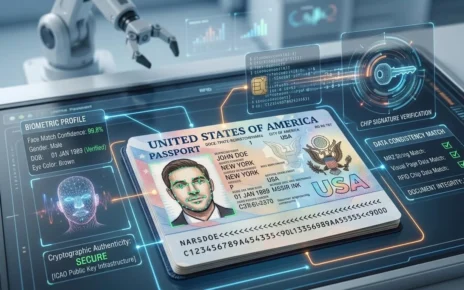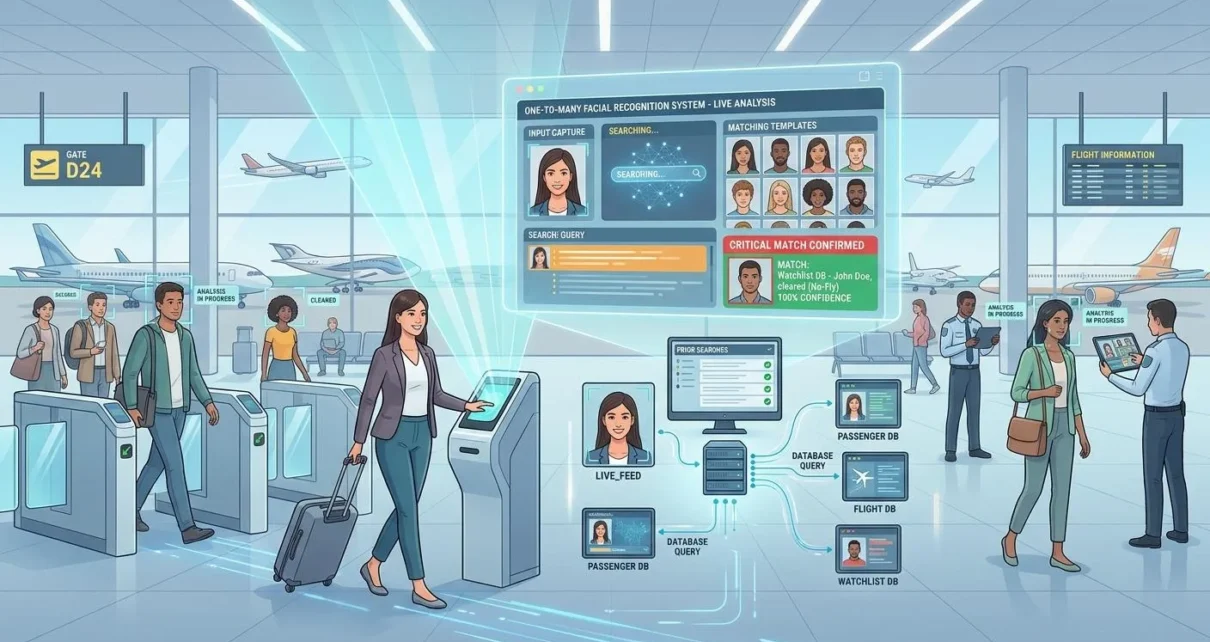
The technology searches a defined gallery for a potential match instead of comparing a traveler to a single reference image, allowing airport systems to identify someone among expected passengers while remaining fundamentally different from simple one-to-one passport verification.
WASHINGTON, DC, October 26, 2026. Facial recognition at an airport gate can operate in more than one way, and one of the most important distinctions is whether the system compares a traveler to a single reference photograph or searches a limited gallery of potential identities associated with the immediate travel environment.
One-to-One and One-to-Many Are Different Biometric Tasks
A one-to-one facial comparison starts with a claimed identity and asks whether the live photograph matches the reference image for that person, such as when an airport system compares a traveler directly with the portrait stored in the electronic passport being presented.
One-to-many facial recognition starts with a different question: the system receives a live facial image and searches a collection of possible reference identities to determine whether one candidate produces a sufficiently strong similarity result.
At an international boarding gate, that collection can be deliberately restricted to travelers expected aboard a particular flight, making the process a targeted one-to-many search rather than an unrestricted attempt to identify an unknown person across every government photograph available.
The distinction is fundamental because verification asks whether this person matches this known identity, while identification asks which person within this defined candidate population most closely corresponds with the face currently presented to the system.
Flight Manifests Help Define the Search Population
Before boarding begins, airlines provide passenger manifest information identifying travelers expected to depart on a particular international flight, allowing government systems to assemble a smaller population that can reasonably contain the individuals who will eventually approach that departure gate.
U.S. Customs and Border Protection explains that when it receives a passenger manifest, its Traveler Verification Service can build a gallery using photographs associated with the individuals identified on that manifest, including images from passports, visas, previous CBP inspections, and other authorized Department of Homeland Security encounters.
The government service then generates biometric templates from those photographs, creating a flight-specific comparison environment that can be searched when passengers present themselves to airline or airport cameras during boarding.
This manifest-driven approach dramatically narrows the problem because a camera photographing someone boarding one international flight does not need to begin by asking whether the person corresponds with one of millions of unrelated government identities.
A Defined Gallery Makes the Search More Targeted
The term one-to-many can sound as though every traveler’s photograph is automatically searched through enormous national databases, but the practical airport implementation can involve a relatively small gallery constructed from passengers expected at one location and one period.
CBP documentation states that it builds localized galleries using Advance Passenger Information System data and other relevant advance-arrival information, with gallery composition depending upon where and when travelers are expected to enter or depart.
At a boarding gate, the candidates can therefore be tied to one scheduled flight, while another airport, cruise terminal or arrival process can use a completely different gallery containing travelers relevant to that particular operational environment.
The gallery provides contextual information for the recognition system, limiting plausible identities before the live facial image is submitted and making the subsequent one-to-many search much more focused than an open-ended identification operation.
The System Already Knows Who Might Appear
This contextual narrowing helps facial recognition boarding work quickly because airline and government systems have already established the group of people expected to approach the camera before the first passenger begins boarding.
The technology therefore does not generally treat a traveler as a completely unknown individual appearing unexpectedly inside the airport, because the flight manifest indicates that perhaps several hundred specific passengers could plausibly present themselves at that gate.
When the live photograph arrives, the recognition algorithm can compare its facial representation against the templates associated with those expected travelers and determine which candidate, if any, produces a sufficiently strong correspondence.
The result is still one-to-many identification because the gallery contains multiple possible identities, but the system benefits substantially from knowing the immediate travel context before searching.
Government Photographs Supply the Candidate References
The images behind those gallery templates generally originate from government records created before the current flight, including passport issuance, visa processing, earlier border inspections or other authorized Department of Homeland Security interactions.
CBP’s current biometric boarding framework states that gallery photographs can include images captured during previous entry inspections, U.S. passport photographs, U.S. visa photographs and other DHS encounter images associated with people named on the relevant passenger manifest.
The airline therefore does not ordinarily need to create an authoritative biometric enrollment record for every traveler before boarding, because the government can draw upon photographs already associated with established identity and travel-document records.
This arrangement also explains why biometric boarding is closely tied to government infrastructure even when the visible camera belongs to an airline or airport, because the government holds the reference identities needed to perform the one-to-many search.
The Gallery May Contain Templates Rather Than Visible Photographs
Facial recognition systems usually transform photographs into mathematical representations known as biometric templates, allowing software to calculate similarity efficiently without repeatedly examining every image as an ordinary visible photograph.
CBP explains that its Traveler Verification Service generates biometric templates from gallery photographs and stores them in its cloud environment for matching, while the original photographs remain in the government systems from which they came.
The agency further states that the templates TVS uses are specific to the algorithm that generates them and cannot be reverse-engineered to recreate the original photograph.
This distinction matters because one-to-many recognition at the gate can transform a live photograph into a numerical representation and compare it against a gallery of other numerical representations, rather than visually flipping through hundreds of passport portraits.
The Live Photo Becomes the Search Probe
When the traveler reaches the participating departure gate, an airline- or airport-owned camera captures a live photograph and sends it securely to the Traveler Verification Service for comparison against the gallery associated with that flight.
In biometric terminology, the newly captured representation is the probe because it is the biometric sample searched against the larger collection of enrolled or pre-positioned reference templates.
The comparison service calculates similarity between the probe and gallery candidates before determining whether a reference exceeds the system’s configured threshold enough to support a potential identification.
If it finds a sufficient match, the service returns the relevant verification result to the participating boarding system, allowing the airline to continue the passenger-processing workflow without unrestricted access to all government photographs underlying the gallery.
A Potential Match Is Not Mathematical Certainty
One-to-many facial recognition should not be interpreted as identifying a traveler with absolute certainty because recognition algorithms calculate similarity between biometric representations and use decision thresholds to determine whether a candidate result is sufficiently strong for the intended operational purpose.
The system may identify one gallery candidate as substantially more similar than the others, but image quality, aging, lighting, pose, and characteristics of the available reference photographs can influence the resulting comparison.
This is why operational systems maintain fallback procedures for cases where the facial search does not produce a sufficiently strong result or generates information requiring additional confirmation before the boarding process can continue.
The recognition result therefore provides evidence supporting identity verification rather than transforming a statistical facial comparison into unquestionable proof that no other explanation is possible.
Thresholds Determine Whether the Result Is Accepted
Recognition systems use configured thresholds to determine how strong a similarity score must be before the software treats a candidate as an acceptable potential match, balancing the risk of accepting incorrect identities against rejecting legitimate passengers.
A threshold set too loosely could increase the risk of a false positive, while an excessively strict threshold could send more legitimate travelers to manual verification because normal changes in appearance or image quality prevent automated acceptance.
Airport systems therefore select thresholds according to operational requirements, recognition performance and the consequences associated with incorrect automated decisions, rather than relying upon one universal similarity percentage that applies equally across every facial recognition deployment.
The existence of a gallery adds another consideration because the system compares the probe with several candidates, meaning developers and agencies must evaluate how recognition performance behaves under the candidate population and image conditions expected within the actual airport environment.
A False Positive Means the Wrong Candidate Was Selected
One particular concern in one-to-many identification is the false positive, which can occur when the system incorrectly matches a traveler’s live photograph to another person in the gallery.
CBP’s current carrier biometric boarding framework addresses this possibility by requiring participating carriers to manually review travel documents when they identify a traveler whose facial image has been incorrectly matched to another passenger.
The agency also provides redress procedures for circumstances where an incorrect biometric association creates an erroneous travel record, demonstrating that automated recognition results remain subject to correction rather than being treated as inherently infallible.
Manual review becomes especially important in one-to-many systems because the potential error does not merely involve rejecting the correct identity, but can involve incorrectly selecting another candidate from within the gallery.
A False Negative Creates a Different Problem
A false negative occurs when the traveler is genuinely represented within the gallery, but the system fails to produce an acceptable biometric match, potentially because the live photograph or available reference images differ too substantially for the configured threshold.
Lighting problems, facial orientation, aging, changes in appearance, and poor image quality can all affect the comparison, so an unsuccessful one-to-many search does not, by itself, establish that the traveler presented false documents or attempted deception.
CBP’s boarding framework requires participating carriers to verify the passenger manually through existing travel-document procedures when TVS does not produce a match for any reason.
This fallback shows how biometric recognition supplements, rather than replaces, traditional passport verification, allowing legitimate travelers to proceed through established procedures when the automated search cannot confidently resolve identity.
One-to-One Verification Starts With a Claimed Identity
The contrast becomes clearer when an electronic passport gate performs a one-to-one comparison, where the traveler physically presents a passport, and the system already knows exactly which reference photograph to use.
The inspection equipment can retrieve the portrait associated with that passport, capture a live photograph and ask whether those two facial representations appear sufficiently similar, without needing to determine which identity within a larger candidate collection belongs to the traveler.
Conceptually, this process compares one live image to one reference image, making the identity claim part of the transaction before the facial recognition algorithm begins.
By comparison, biometric boarding lets the face serve as the initial identifying credential because the system searches the defined passenger gallery to determine which expected traveler is standing before the camera.
One-to-Many Lets the Face Function as an Identifier
This ability to identify the passenger from a gallery explains why biometric boarding can sometimes reduce the need to scan a boarding pass or repeatedly present travel documentation during individual airport touchpoints.
The system knows a limited group of passengers is expected, captures the person approaching the gate, and searches the corresponding gallery until it identifies a candidate whose facial characteristics meet the required similarity threshold.
Once it identifies that candidate, the boarding system can link the live traveler to the relevant passenger record and determine whether the person can continue through the airline’s normal departure workflow.
The face therefore functions more like an identifier during one-to-many recognition, while one-to-one comparison uses the face principally as evidence confirming an identity that has already been claimed through another credential.
The Search Gallery Does Not Have to Be Permanent
A gallery built for one international flight exists for a specific operational event, so the government can stage the relevant templates around the expected departure without maintaining that exact collection indefinitely after the flight ends.
The source photographs used to create the gallery can remain within their original passport, visa or border systems according to separate records-management rules, while the temporary collection assembled for matching can follow its own shorter operational lifecycle.
This distinction becomes important in privacy discussions because deleting a flight gallery does not erase the original passport photograph, while deleting a traveler’s live boarding image does not necessarily erase the government’s official record showing that the individual departed.
One-to-many recognition therefore involves several information layers whose retention should be considered independently, rather than assuming that every photograph or template participating in the same search remains available for the same period.
Airlines Do Not Need the Whole Gallery
The architecture of biometric boarding also lets participating airlines use one-to-many government identification without necessarily gaining direct access to every passport and visa image in the government’s reference population.
DHS documentation explains that airline or airport cameras connect securely with TVS, which performs the backend comparison and returns the match result needed to continue passenger processing.
This separation reduces the amount of sensitive government identity information that commercial transportation partners must possess, because the airline needs confirmation that the traveler has been successfully identified rather than unrestricted access to the underlying facial gallery.
The approach lets government identity infrastructure serve as a verification service for the boarding transaction while keeping authoritative source records under government control.
One-to-Many Recognition Does Not Decide Immigration Admission
A successful one-to-many boarding match identifies a likely passenger within the flight gallery, but it does not establish that the destination country must admit that individual after arrival.
Immigration admissibility depends upon visas, nationality, travel purpose, immigration history and other legal requirements administered by the destination government, none of which becomes automatically resolved merely because the departure facial recognition system identified the passenger successfully.
The airline still has separate responsibilities for travel documentation, and CBP’s biometric boarding framework explicitly requires carriers to ensure passengers have valid passports or other authorized travel documents despite successful TVS facial verification.
The one-to-many search therefore answers a comparatively narrow identity question within the boarding workflow rather than functioning as a comprehensive legal authorization for international travel.
Passport Security Remains a Separate Layer
Electronic passports include security mechanisms to establish authenticity and protect identity information, while one-to-many facial recognition addresses a different question: which expected passenger appears before the airport camera.
Amicus International Consulting examines the relationship among document authentication, electronic chip security, and biometric holder verification in its guide to how modern passports help detect counterfeits and protect identity, treating these technologies as complementary rather than interchangeable safeguards.
A boarding gallery can contain a biometric reference ultimately derived from a passport photograph, but the facial search itself does not replace cryptographic passport validation or the physical document checks required elsewhere within the international travel process.
Understanding this separation prevents the common misconception that recognizing a passenger’s face automatically establishes every aspect of travel-document authenticity and immigration eligibility at the same time.
Traveler Choice Remains Relevant
CBP’s current biometric boarding test allows individual travelers to decline the facial photograph and instead undergo established manual identity and passenger-manifest verification, while participating carriers must display information that the biometric procedure is voluntary within that program.
Choosing conventional verification does not eliminate the traveler’s responsibility to present valid international travel documentation because the alternative changes only the mechanism used to associate the passenger with the flight record.
This distinction matters because one-to-many recognition can add convenience and speed without necessarily becoming the only way to prove identity during the specific boarding process covered by those procedures.
Travelers should nevertheless distinguish this airline and CBP boarding choice from biometric requirements imposed independently through immigration law, because another border process can operate under a different legal framework even within the same airport.
The Defined Gallery Is the Key Concept
The easiest way to understand one-to-many airport facial recognition is therefore to imagine a system receiving one live traveler photograph and asking which identity, if any, within a limited collection of expected passengers produces the strongest acceptable correspondence.
The gallery can contain several hundred candidate templates rather than one reference, but the population remains linked to the travel event through airline manifest information and existing government identity records.
This differs significantly from one-to-one passport verification, where the document establishes identity and facial recognition merely tests whether the person resembles the portrait associated with that document.
It also differs from an unrestricted facial search across an enormous general population because flight information gives the government a practical basis for narrowing the candidate set before matching begins.
Airport Context Makes One-to-Many Recognition Practical
Airports provide an unusually structured environment for this type of technology because airlines know passenger itineraries, scheduled departure times, gate assignments, and manifest identities before the traveler reaches the boarding camera.
That advance information lets government systems turn what could otherwise become a massive facial identification problem into a focused search of the relatively small group expected at a particular place during a particular period.
The technology can then return a candidate result within seconds, making the process fast enough to integrate into commercial boarding operations where hundreds of travelers must pass through the gate without creating significant additional delay.
The speed passengers experience therefore comes not solely from increasingly sophisticated facial recognition algorithms, but from how airline information and government identity records narrow the search before the first live image is captured.
One-to-Many Recognition Is About Identification Within Context
At an airport gate, one-to-many facial recognition is ultimately a contextual identification technology that uses the manifest to define who might reasonably appear, then searches that candidate population for a potential biometric match.
Its effectiveness depends upon accurate passenger information, appropriate government reference photographs, strong image capture, reliable recognition algorithms, and decision thresholds calibrated for the operational environment in which boarding occurs.
When those elements work together, the passenger can be identified without repeatedly presenting the same documents at every participating touchpoint, while conventional verification remains available when the biometric search cannot produce an acceptable result.
For travelers trying to understand what happens behind the camera, the crucial distinction is therefore straightforward: one-to-one asks whether a face matches one known person, while one-to-many searches a defined gallery to determine which expected person, if any, the face most likely represents.