Removing an image from boarding equipment does not necessarily erase records held by the agency processing the identity check, because commercial carriers and government authorities can receive the same photograph under different legal, technical and operational rules.
WASHINGTON, DC, October 23, 2026. When an international passenger uses facial recognition at a participating airport boarding gate, the airline may be required to delete the photograph almost immediately, while the government agency receiving that same image can process or retain information under entirely separate rules governing biometric identity verification and border records.
One Photograph Can Enter Two Different Information Environments
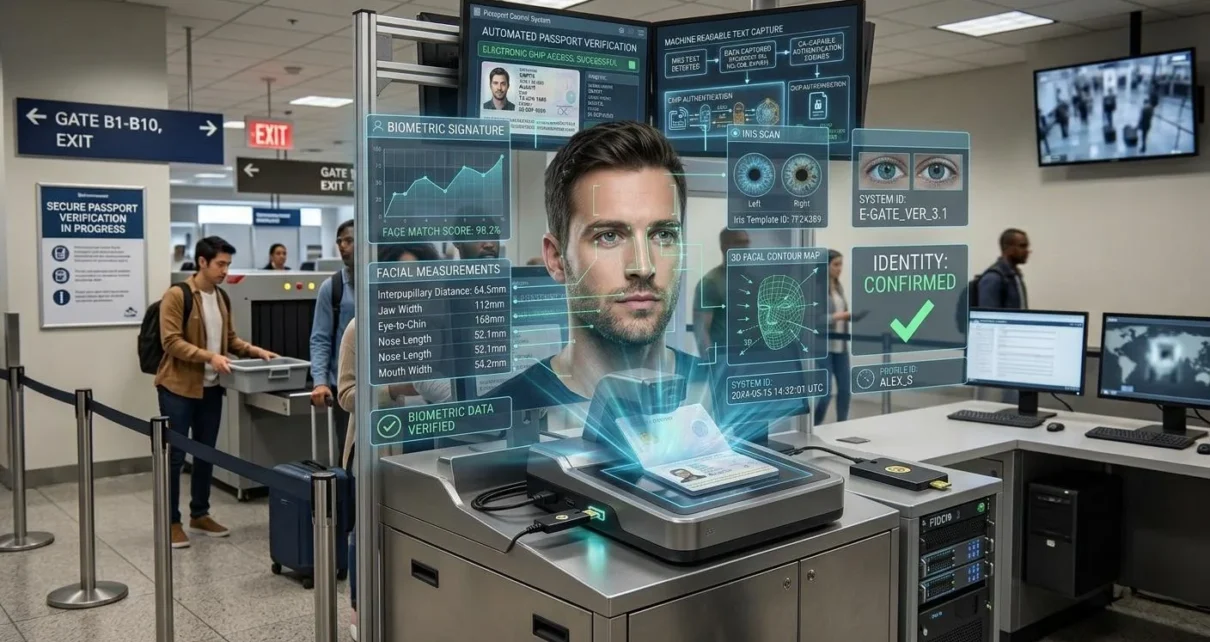
The photograph captured as a passenger approaches an international boarding gate can briefly exist within airline or airport-controlled equipment before being transmitted through secure infrastructure to a government identity service that performs the facial comparison and returns the result needed for boarding.
That apparently simple transaction creates an important privacy distinction because the commercial organization operating the camera and the government agency conducting the comparison do not necessarily possess identical authority to store, reuse or retain the photograph after the identity check has finished.
Under the United States biometric departure program, participating airlines and airport authorities operate under government requirements that limit their ability to keep photographs collected specifically for Customs and Border Protection facial comparison, even though CBP receives the same images for government processing.
Current Department of Homeland Security documentation states that participating airlines, airport authorities and cruise partners must purge photographs immediately following transmission and cannot retain photographs collected through the government biometric process for their own commercial purposes.
The Airline’s Deletion Obligation Is Deliberately Strict
CBP’s requirements for biometric air exit specify that photographs captured to facilitate Traveler Verification Service matching must not be stored or retained by the participating business sponsor, systems integrator or vendor after the traveler has completed the relevant boarding transaction.
The requirement extends beyond the airline whose name appears on the passenger’s ticket because technology contractors and systems integrators participating in the same government-supported process must also comply with the restrictions governing photographs collected specifically for the federal matching service.
CBP also requires participating systems to provide an agreed method for the agency to audit compliance with the deletion requirement, making the photograph-retention rule an operational condition of participation rather than merely a voluntary privacy promise.
These safeguards mean an airline can operate the camera and temporarily possess the image without receiving unrestricted authority to build a permanent commercial facial database from photographs collected for the government-supported boarding process.
Government Receipt Creates a Separate Privacy Question
Once the live photograph is transmitted to CBP, however, the airline’s deletion requirement no longer addresses what happens to the government copy because CBP processes the image under federal authorities and retention policies tied to biometric entry and exit operations.
The CBP biometric travel program uses facial comparison to connect newly captured traveler images with photographs already associated with passports, visas, travel documents or earlier government encounters, allowing identity verification to occur without requiring carriers to possess the complete government reference collection.
Federal privacy materials distinguish among traveler categories and government systems, meaning the retention applied after CBP receives a photograph can depend upon citizenship, immigration status and whether the image serves as confirmation of a legally required biometric departure.
A photograph can therefore disappear from the airline’s boarding equipment while information associated with the same facial comparison remains within federal infrastructure, making commercial deletion and government retention fundamentally different stages of the information lifecycle.
U.S. Citizens Receive More Limited Government Retention
CBP states that it retains photographs of United States citizens participating in its standard biometric departure process only briefly, and current public privacy material describes deletion within twelve hours after biometric identity verification.
Earlier and current DHS privacy documentation similarly explains that the standard Traveler Verification Service process does not enroll photographs of confirmed United States citizens as long-term biometric exit records, although confirmation of the crossing and associated biographical information can remain in separate government systems.
This distinction matters because deleting the live photograph does not erase the fact that the passenger departed the country, since travel-history information and the photograph used to confirm identity are different categories of records.
The privacy question therefore requires separating the government’s handling of the facial image from its handling of the passenger’s border-crossing information, just as airline deletion must be distinguished from government deletion.
Certain Foreign Travelers Face Different Retention Rules
For foreign nationals covered by statutory biometric exit requirements, the government can retain photographs in secure Department of Homeland Security systems to confirm that the person associated with an immigration record actually departed the United States.
That longer government use serves a purpose distinct from airline boarding because the carrier needs the facial comparison primarily to establish passenger identity, while the federal government can use the same biometric event to satisfy requirements associated with recording international departure.
Consequently, the same photograph can have a very short commercial lifecycle and a longer governmental lifecycle without contradiction, because each organization receives the image for a different purpose and operates under a separate set of legal responsibilities.
This is one reason broad statements claiming that biometric boarding photographs are immediately deleted can mislead travelers unless those statements specify whether they describe the airline copy, the government copy or another record created from the same transaction.
A Government System Can Retain the Border Event Without Retaining the Picture
Biometric identity verification also produces results that can become part of broader travel records even when the original facial photograph eventually disappears, allowing government authorities to maintain evidence that a particular person crossed the border without indefinitely keeping every image used during the comparison.
DHS privacy documentation describes CBP maintaining crossing confirmations and associated biographical information separately from the temporary handling of certain facial photographs, showing that image deletion and border-record deletion are not interchangeable.
A passenger can therefore have the airline photograph deleted, the government facial image subsequently deleted according to the applicable rule and the underlying departure event remain recorded because immigration administration requires information about when the traveler left the country.
Understanding these layers becomes increasingly important as border processing shifts from passport stamps to centralized digital records that travelers can no longer see after the journey ends.
The Matching Service Also Creates Temporary Technical Information
Facial recognition normally converts photographs into mathematical representations that let algorithms compare facial characteristics efficiently, meaning additional information can be generated between initial image capture and the final identity result returned to the airline.
Government privacy documentation describes the Traveler Verification Service as creating biometric templates from historical and newly captured photographs, allowing the matching process to operate without treating every comparison as a simple visual examination of ordinary image files.
Those templates have their own technical lifecycle, so asking only whether the photograph was deleted can provide an incomplete picture of everything produced during the facial recognition transaction.
A complete privacy analysis needs to distinguish the airline photograph, the government photograph, any temporary biometric template, the returned match result, and the border-crossing record because each information object can follow a different retention schedule.
The Airline Receives a Limited Identity Result
Participating airlines generally do not need access to the entire government biometric environment because their immediate operational requirement is knowing whether the traveler standing at the boarding gate corresponds with an expected passenger.
Recent DHS documentation on expanded Traveler Verification Service use states that airlines do not receive the underlying biometric-matching data, reinforcing the separation between the government comparison infrastructure and the commercial systems that rely on its results.
The government can therefore compare the live image against passport or trusted traveler references and return only the information the airline needs to continue processing the passenger, limiting unnecessary transfer of federal identity information into commercial databases.
That architectural boundary becomes another privacy safeguard because the airline can benefit from government-supported biometric verification without receiving every photograph, biometric template or government identity record involved behind the scenes.
Airline Deletion Can Still Provide Significant Protection
The government may retain information, but airline deletion still matters because removing facial images from commercial boarding systems reduces the number of places where highly sensitive biometric information remains after the passenger leaves.
Airlines and airports operate extensive technology networks, including check-in counters, mobile applications, bag-drop stations, departure gates, and third-party service providers, so unnecessary long-term duplication of government-verified photographs creates an additional security risk that privacy requirements can reduce.
Immediate commercial deletion helps prevent a temporary identity-verification photograph from becoming another historical customer record that might later be used for unrelated analytics, marketing or identification without a separate lawful basis and appropriate notice.
Data minimization therefore remains valuable even when one authorized government copy survives because reducing the number of independent repositories lowers the exposure created by maintaining the same sensitive information across several organizations.
Separate Airline Programs Can Follow Different Rules
An airline can operate its own facial recognition or identity technology independently of the CBP-supported boarding process, so photographs collected for a separate commercial service may be governed by another privacy notice rather than the government program’s deletion requirements.
CBP’s business requirements specifically recognize this possibility and require participating organizations to distinguish independently operated commercial biometric programs from the government-enabled Traveler Verification Service process through signage and other public notices.
This distinction prevents travelers from assuming that every facial recognition camera carrying an airline logo follows the same federal deletion requirements simply because the carrier also participates in CBP biometric boarding elsewhere inside the airport.
The purpose for which the photograph is collected consequently matters as much as the organization operating the camera, because the same airline can potentially participate in separate biometric workflows governed by different rules.
Technology Vendors Can Also Temporarily Handle the Image
Airport biometric boarding frequently depends upon technology companies providing cameras, networking systems, boarding gates or integration software, meaning the live photograph can technically pass through infrastructure supplied or managed by organizations other than the airline and CBP.
The government’s business requirements extend relevant retention restrictions to systems integrators and vendors participating in the TVS-enabled process, preventing those contractors from becoming alternative repositories for photographs that the airline itself must delete.
That contractual extension matters because privacy protections would weaken substantially if an airline deleted its copy while the technology provider responsible for moving the photograph between the camera and government service retained another version indefinitely.
Modern biometric privacy therefore depends upon controlling the entire processing chain rather than regulating only the company whose brand travelers can see beside the departure gate.
Secure Transmission Does Not Determine Retention
Security measures protect photographs transmitted to government systems as they travel between airport infrastructure and federal services, but encryption and retention address separate privacy questions.
Encryption protects the photograph during transmission and storage by making unauthorized access more difficult, while retention policy determines how long an authorized organization continues to maintain that information after its immediate purpose has been completed.
A photograph can therefore be securely encrypted and retained for years, or strongly encrypted and deleted within seconds, depending on the legal and operational requirements that apply to the organization controlling that copy.
Travelers should consequently avoid treating cybersecurity statements as substitutes for retention disclosures because strong technical protection does not independently explain whether information will remain available tomorrow, next month or several years later.
The Source Passport Photograph Follows Another Lifecycle
The live boarding image is also different from the government photograph against which it is compared, since the reference image can originate from passport issuance, visa processing, trusted traveler enrollment or another earlier government interaction.
Deleting the live photograph captured at the gate does not delete that preexisting reference photograph because the source image belongs to an independent government record established before the current journey and governed by separate retention rules.
Likewise, a temporary flight gallery’s expiration does not erase the passport photograph from the government system that originally supplied it, showing how multiple copies or representations of one person’s face can participate in a biometric transaction without sharing a single deletion deadline.
Amicus International Consulting examines the relationship among official passport photographs, electronic document protection, and identity verification in its guide to modern passport security and identity protection, treating these layers as complementary components rather than one unified database.
Deleting the Photo Does Not Cancel the Boarding Record
The airline itself can also maintain ordinary records showing that the passenger boarded the flight even after purging the facial image, because reservation, ticketing and passenger-manifest information serves commercial and regulatory purposes independent from biometric recognition.
The biometric photograph simply links the individual at the gate to the passenger record the carrier already maintains, so the identity check can disappear while the transportation record survives.
Government systems can similarly preserve information showing that a particular traveler departed, even when policy requires deleting the live facial photograph after identity verification is complete.
This separation shows a recurring principle across digital borders: deleting one sensitive data element does not necessarily erase the transaction in which that information was originally collected.
A Non-Match Can Produce a Different Processing Path
When facial recognition fails to return an acceptable result, the traveler can be redirected toward conventional document verification, allowing airline personnel or government officers to establish identity without treating the automated outcome as definitive evidence of wrongdoing.
A non-match may result from lighting, camera angle, changes in appearance or another ordinary image-quality issue, making human-readable passports and established boarding procedures an important fallback within the biometric environment.
The resulting manual interaction can produce records that differ from those associated with a successful biometric transaction, especially when additional government inspection becomes necessary for reasons beyond simple facial-image quality.
Retention questions therefore depend not only on who captured the initial photograph but also on what happened next during the passenger’s broader border or boarding interaction.
Traveler Choice Can Determine Whether the Live Image Exists
CBP’s current biometric departure privacy information states that travelers who do not wish to have a photograph taken can notify an airline, airport representative or CBP officer and undergo another method of identity and document verification within the applicable departure program.
Separate TSA and airline workflows connected with TVS similarly describe live facial capture as dependent on traveler consent, directing passengers who decline to standard security or processing procedures instead.
Choosing conventional verification can therefore prevent creation of that particular live boarding photograph, although the traveler’s airline reservation, passport information, passenger manifest entry and other ordinary travel records continue to exist independently.
This distinction reinforces why biometric privacy involves much more than retention alone because collection, consent, transmission, processing and deletion all occur at different stages of the information lifecycle.
The Government Record Exists Under a Different Legal Purpose
For certain foreign nationals, government retention of biometric departure information exists because federal law requires the United States to record biometric entry and exit information, giving CBP a governmental purpose that extends well beyond an airline’s need to board a passenger efficiently.
The carrier’s purpose largely ends once it has verified and boarded the individual, while the government’s immigration purpose can continue because confirming departure contributes to the traveler’s official border history and future immigration processing.
That difference explains why identical photographs can be subject to different deletion rules without either organization necessarily violating the privacy commitments governing its role.
Retention follows the purpose and legal authority attached to each copy, not the physical camera that originally created the image.
Privacy Notices Need to Identify Which Copy They Describe
Statements such as your photo is deleted immediately sound straightforward, but meaningful biometric privacy disclosures need to identify whether that promise applies to the airline’s capture system, the government matching environment or every copy generated during the transaction.
CBP’s current materials make the distinction clearer by requiring commercial partners to purge boarding photographs while separately explaining how the government handles them for U.S. citizens and covered foreign nationals.
Travelers reading other biometric privacy notices should look for the same level of precision because the organization operating the camera, the organization conducting the facial comparison and the organization maintaining the official government record may be entirely different entities.
Without that distinction, a technically accurate deletion statement can give an incomplete picture of what happens to biometric information after the passenger walks away from the gate.
Airline and Government Retention Must Be Evaluated Separately
The most accurate way to understand biometric boarding privacy is therefore to follow the photograph through every organization that handles it rather than treating the image as one record controlled by whichever company appears most visible inside the terminal.
The airline or airport partner captures the photograph, participating technology systems support transmission, CBP performs the government comparison and separate retention rules determine what each participant may continue storing after the identity result has been returned.
Commercial partners must delete the photographs collected for the government-enabled process, while government retention can continue under rules that vary substantially by citizenship and statutory biometric obligations.
That distinction doesn’t make biometric boarding uniquely complicated, but it shows a broader reality of modern digital identity systems: one brief interaction can create multiple technically related records governed by independent organizations.
Deletion at the Gate Is Only One Stage of the Data Lifecycle
For passengers, deleting the photograph from boarding equipment can provide meaningful privacy protection, especially because it prevents airlines and their participating vendors from accumulating government-verified images simply because they operated the collection hardware.
The more complete privacy picture begins after that deletion, however, when travelers consider whether CBP still possesses the live image, whether the government created a biometric departure record and whether separate airline or federal records continue documenting the journey without retaining the photograph itself.
Understanding this distinction turns a seemingly simple question about whether my boarding photograph was deleted into several more useful questions concerning which copy, which organization, which traveler category and which government purpose are involved.
As facial recognition becomes increasingly routine throughout international aviation, airline photo deletion and government retention will remain separate privacy questions because removing an image from a commercial boarding system cannot automatically erase information already transmitted into the sovereign border infrastructure responsible for processing the identity check.