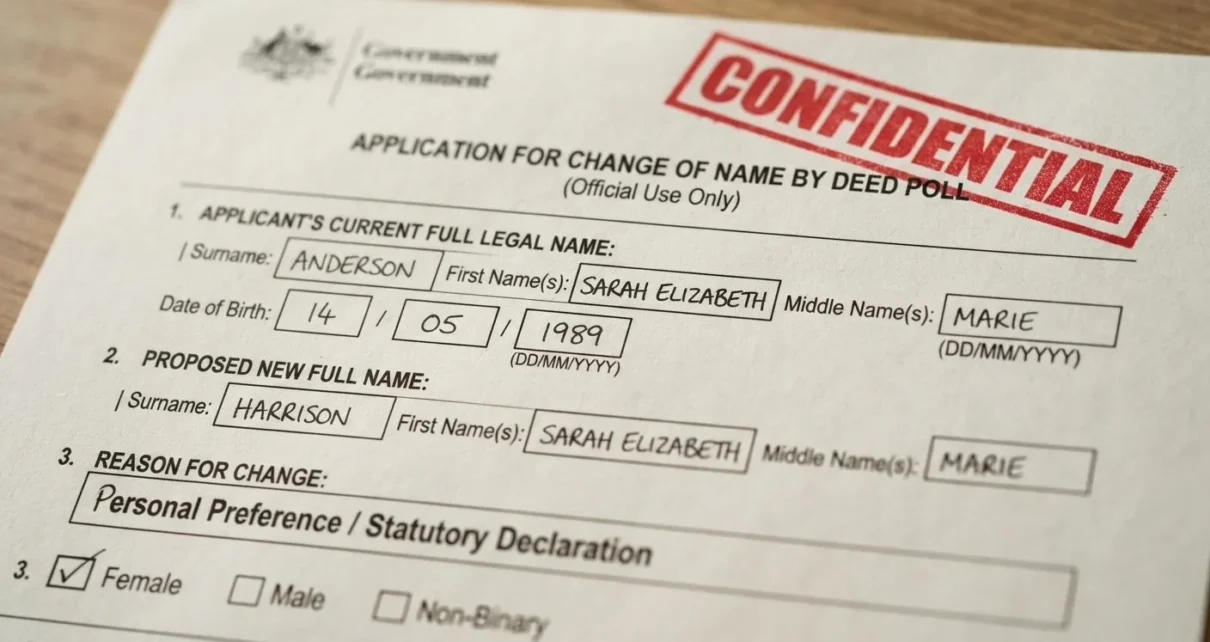
Applicants seeking restricted disclosure may need evidence explaining a safety threat and demonstrating why the available legal protections apply to their circumstances.
Washington, DC, November 3, 2026 — People seeking a confidential name change may need to explain how public disclosure would affect their safety, but the applicable requirements depend on state law, and some jurisdictions provide confidentiality without requiring proof of an individual threat.
That distinction matters because a preference for privacy, eligibility for a protected category and a request supported by evidence of danger can represent different legal grounds, each requiring attention to the procedure that actually applies.
Applicants should not assume that a police report or protective order is always necessary, just as they should not assume that requesting confidentiality automatically prevents public access to every document associated with a name-change proceeding.
The practical task is to identify the available protection, establish any required eligibility and understand its scope before filing, particularly where an ordinary application could disclose information that the applicant is trying to keep private.
The Legal Basis Determines What Must Be Shown
A confidentiality request should begin with the governing statute or court rule, because the applicant needs to know whether protection follows automatically from the type of proceeding or requires a separate judicial assessment of particular circumstances.
A safety-based provision may ask whether disclosure would create or increase danger, while another provision may protect an entire category of cases without requiring each applicant to document threatening incidents or obtain an individualized safety finding.
These approaches should not be combined into a universal checklist, because doing so could impose unnecessary evidentiary demands on some applicants while leaving others unaware of the explanation their particular court requires before granting relief.
A useful initial inquiry therefore identifies the precise legal basis for confidentiality and the required filing method, rather than starting with a collection of sensitive documents whose relevance has not yet been established for the proceeding.
New York Considers the Full Circumstances
Under New York’s law governing sealed name-change papers, a court must seal the proceeding when it finds that an open record would jeopardize the applicant’s personal safety, assessed through the totality of the circumstances.
The statute expressly includes consideration of violence or discrimination risks, including circumstances involving a transgender applicant or a person subjected to domestic violence, rather than limiting the inquiry to one narrowly defined category of documented incident.
It also prohibits denying sealing solely because the applicant lacks specific instances or a personal history of threats, an important qualification for people who reasonably fear exposure but have never obtained an incident report or protective order.
The provision demonstrates why applicants should distinguish explaining their circumstances from proving that violence has already occurred, because the statutory inquiry allows consideration of risk without making a history of personally documented threats an absolute prerequisite.
Protection During the Application Can Matter
The timing of confidentiality deserves attention because a request intended to prevent disclosure may lose practical value if sensitive identifying details enter publicly accessible records before the court considers whether protection should apply to the proceeding.
New York Courts explains that an applicant raising qualifying safety concerns can seek immediate sealing while the court considers the request, distinguishing protection during the pending case from the decision concerning continued confidentiality after judicial review.
Its public guidance directs applicants toward the clerk, court help services or appropriate legal assistance to learn how to request that protection, emphasizing the importance of using the correct procedure when submitting the initial papers.
Applicants should therefore ask how confidential materials must be submitted before delivering a standard filing package, rather than assuming that a statement expressing concern will change how every attachment is processed or displayed.
Some California Proceedings Receive Automatic Protection
The California Courts confidentiality guide describes protections applying to specified gender-related name-change and recognition proceedings filed from July 1, 2026, showing that some applicants do not need to establish a separate individualized threat to obtain confidentiality.
For qualifying petitions filed on or after that date, the guidance explains that the court automatically keeps the relevant records private, while people with qualifying earlier filings must request protection through the procedure the court identifies.
The guide also distinguishes authorized access before and after approval, illustrating that a protected record can remain available to specified people without being generally accessible to members of the public searching for the case.
This framework should not be generalized to every California name-change petition, because the protection described applies to defined proceedings and requires applicants to identify whether their own request falls within those categories before relying on it.
Massachusetts Illustrates a Different Default
Massachusetts amended its name-change law effective November 25, 2025, establishing that petitions, related documents and docket entries are unavailable for inspection unless the petitioner requests access or the court orders otherwise for good cause.
The amended statute also changes the treatment of public notice, allowing the court to require it for good cause rather than presenting publication as the ordinary requirement that every applicant must individually seek to avoid.
Massachusetts court guidance explains that documents filed in connection with name-change petitions after the effective date are impounded, while earlier petitions do not automatically receive that treatment under the change described in its public guidance.
These provisions significantly qualify any suggestion that confidentiality always requires evidence of danger, because a statutory default can protect records without requiring the applicant to show a personal safety threat as the threshold condition.
Program-Based Protection Has Its Own Eligibility Rules
California’s Safe at Home program provides another route, with the Secretary of State explaining that eligible enrolled participants may seek confidential name changes for reasons connected to domestic violence, stalking, sexual assault or human trafficking.
The agency distinguishes enrollment and eligibility from the court proceeding itself, explaining that qualifying participants can request a confidential name-change packet while the legal process remains under judicial supervision rather than being completed by the program.
Its guidance also explains that program staff cannot provide legal advice or help with the court process, directing participants who need that support to legal counsel or the appropriate county court self-help services.
For applicants, the key distinction is that a general wish to limit disclosure does not establish eligibility for this route, which depends on the program’s requirements and the circumstances identified in the governing framework.
Washington Recognizes Several Protected Circumstances
Washington’s name-change statute provides a superior-court route for specified circumstances, including qualifying immigration statuses, emancipated minors and requests connected to gender expression or identity, demonstrating that protected procedures can extend beyond documented domestic violence incidents.
The same provision addresses requests arising from an experience of, or reasonable fear of, domestic violence, stalking, unlawful harassment or coercive control, making the wording of the relevant category important when evaluating the applicant’s circumstances.
Washington’s Administrative Office of the Courts explains how these categories are handled as confidential name-change cases, linking the court’s treatment of the filing to statutory provisions restricting public access to the proceeding and its records.
The example reinforces the need to identify the correct category and court, rather than assuming that every person seeking confidentiality must satisfy the same factual test or present the same type of supporting document.
A Factual Explanation Should Address the Requested Protection
Where an individualized explanation is required, a useful statement connects the information that would become public with the concern motivating the request, allowing the court to understand why the applicant seeks the particular restriction on disclosure.
Depending on the applicable procedure, relevant material might include an existing protective order, threatening communications or records describing unwanted contact, but these examples should not be presented as a mandatory documentary package required in every jurisdiction.
The applicant’s account should distinguish events personally observed from information received from others, and explain any uncertainty accurately rather than overstating the available evidence to make the request appear more persuasive.
Professional assistance can help determine what material is relevant and how to submit it, particularly when an attachment contains another person’s private information or could reveal details beyond what’s necessary to explain the requested protection.
Supporting Records Also Need Careful Handling
Preparing evidence creates its own disclosure questions, because an otherwise relevant document may contain addresses, contact information or identifying details that require special treatment under the court’s rules before it can be safely included in a filing.
Applicants should ask whether the court requires a confidential attachment, separate submission or authorized redaction process, recognizing that an informal instruction written on the front of a document may not establish the legal protection they intend.
Where a record contains information unrelated to the requested relief, the appropriate response is to seek guidance about permissible handling rather than altering evidence in a way that could obscure its meaning or misrepresent its contents.
Keeping an accurate inventory of submitted materials can also help the applicant verify what the court received and identify which documents are covered by any resulting order, especially when additional evidence is filed after the initial petition.
Confidentiality Must Be Distinguished From Other Protections
A waiver of newspaper publication, restricted access to court records and participation in an address confidentiality program address different forms of disclosure, so applicants should identify which protection they need rather than using those descriptions interchangeably.
A request focused on court access should specify the records or information at issue, while questions about mail, agency records or documents held by private institutions may require separate procedures outside the name-change case itself.
The scope of any resulting protection should be assessed through the applicable law and order, including whether authorized people retain access and whether a later court decision can permit disclosure under circumstances identified in the governing framework.
This approach avoids treating confidentiality as an unlimited guarantee, while still recognizing the substantial practical value of preventing routine public access to information that could connect an applicant’s previous and newly approved names.
Commercial Assistance Should Match the Actual Procedure
People considering paid assistance should establish whether a provider is offering administrative support, help locating qualified counsel or another clearly defined service, because the legal requirements for confidentiality remain determined by the relevant jurisdiction and proceeding.
When reviewing Amicus International Consulting’s new-identity services, applicants should identify the specific government process involved and distinguish assistance with that process from any broader suggestion that a commercial service independently determines access to official records.
A written explanation should address who prepares the documents, who provides legal advice where needed and how sensitive information will be handled, allowing the applicant to assess the proposed work against the court’s actual requirements.
The same review should clarify which outcomes remain subject to judicial or agency decisions, particularly where confidentiality depends on eligibility, a factual finding or procedural steps that cannot be replaced by a provider’s assurance of privacy.
A Sound Application Matches the Protection to the Circumstances
The most useful preparation begins by confirming whether confidentiality is automatic, category-based, or dependent on an individualized request, then identifying the forms and supporting information needed to obtain the protection available under that procedure.
Where an explanation of risk is required, the aim should be a truthful account addressing the relevant legal standard, without assuming that the absence of a police report or a previous protective order necessarily defeats the request.
Where confidentiality applies automatically, applicants should still understand which records are covered and who may access them, and confirm the filing followed the correct procedure rather than assuming every administrative step has occurred as expected.
Confidential name changes therefore require careful attention to legal eligibility and procedural scope, with evidence of danger important in some cases and unnecessary in others, making current jurisdiction-specific guidance essential before sensitive information enters the court system.