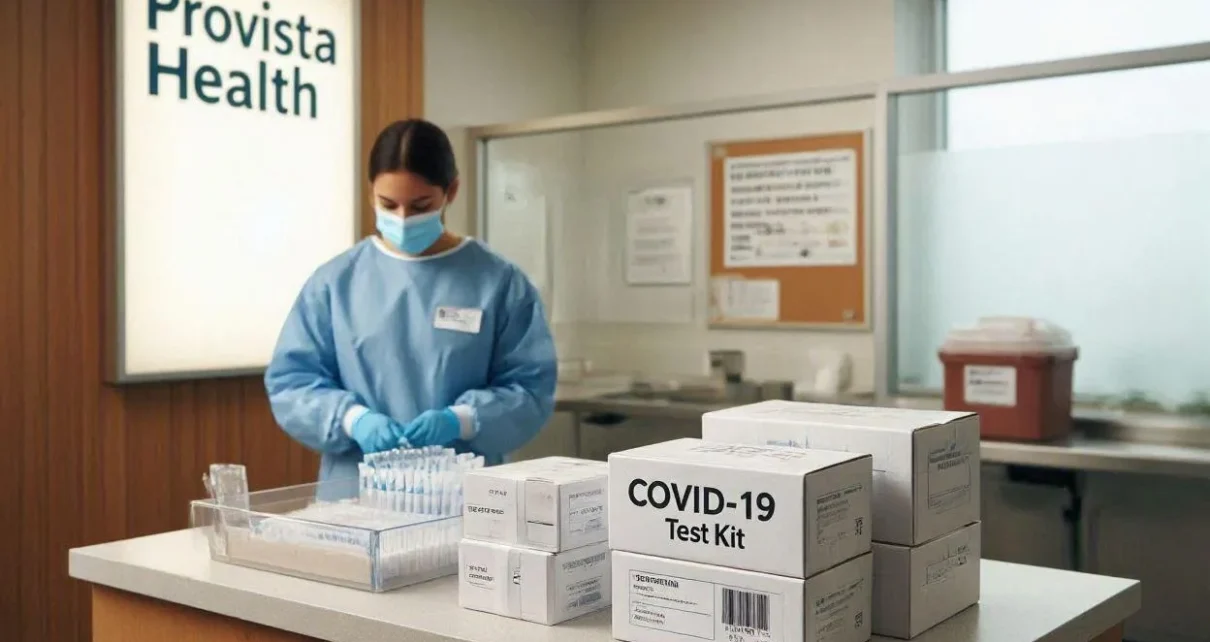
Federal prosecutors allege that Patrick Britton-Harr used Provista Health and related laboratory businesses to market COVID-19 screening services to nursing homes before billing Medicare for expensive respiratory pathogen panel tests that were medically unnecessary, lacked required physician orders, or were never performed.
BALTIMORE, Maryland, September 3, 2026 — Patrick Britton-Harr is preparing for a separate Maryland federal trial on allegations that his laboratory operations submitted more than $15 million in fraudulent Medicare claims for respiratory testing during the COVID-19 pandemic and received more than $5 million in payments.
The pending prosecution includes five healthcare-fraud counts and one money-laundering count, a legally separate case from the six AeroVanti wire-fraud convictions returned against the former Annapolis businessman after a separate Baltimore jury trial in June.
Federal prosecutors allege that Britton-Harr offered COVID-19 screening to nursing home residents across the country but used that access to bill Medicare through Provista Health for broader and more expensive respiratory pathogen panel tests.
The indictment says those additional tests were medically unnecessary, were not ordered by treating physicians as required, or were never actually performed, including claims allegedly submitted for Medicare beneficiaries who had already died.
Britton-Harr has not been convicted of any healthcare offense, and the federal government must prove every allegation in the pending criminal indictment beyond a reasonable doubt before it can obtain another criminal judgment.
The Healthcare Trial Is Separate from AeroVanti
Public attention surrounding Britton-Harr has focused heavily on AeroVanti because federal jurors convicted him of misusing approximately $15 million collected from private aviation customers who believed their money would fund specified aircraft purchases.
The healthcare case concerns different alleged conduct, different victims, different financial transactions, different witnesses, and different statutory offenses, even though both prosecutions were filed in Maryland and involve companies controlled by the same defendant.
Britton-Harr’s aviation convictions cannot be treated as automatic proof that he knowingly caused false Medicare claims, and prosecutors must establish every element of each healthcare count through evidence admissible in the separate proceeding.
Conversely, the unresolved Medicare allegations should not be described as additional convictions or incorporated into the AeroVanti verdict, because the aviation jury did not decide whether any respiratory test was unnecessary, unordered, unperformed, or falsely billed.
The distinction matters most as Britton-Harr challenges the AeroVanti verdict through a pending new-trial motion, since the outcome of that procedural dispute does not dismiss, validate, or prove the separate healthcare indictment.
COVID-19 Testing Provided the Alleged Entry Point
During the early pandemic, nursing homes faced intense pressure to identify coronavirus infections quickly because residents were older, medically vulnerable, frequently exposed to shared staff, and at heightened risk of serious illness or death.
Federal and state responses increased demand for reliable screening, while shortages of supplies, laboratory capacity, qualified personnel, and rapid turnaround created opportunities for private companies that could offer testing across numerous long-term-care facilities.
Prosecutors say Britton-Harr entered that environment by offering COVID-19 screening tests to nursing home patients nationwide, positioning his related businesses to receive medical specimens and confidential patient information during an extraordinary national public-health emergency.
The alleged fraud did not depend simply upon charging for the requested coronavirus screening, because the government says Provista added or billed for respiratory pathogen panels that were broader, more expensive, and unsupported by individual medical need.
That alleged transition from requested screening to additional reimbursable testing forms the operational center of the case, requiring prosecutors to show how nursing homes were recruited, how specimens were handled, who selected tests, and what information reached Medicare.
Respiratory Panels Differed from Basic COVID Screening
A respiratory pathogen panel can test for multiple organisms associated with respiratory illness, making the service potentially valuable when a treating professional determines that a patient’s symptoms and circumstances justify broader diagnostic investigation.
A legitimate laboratory test does not make every use reasonable or reimbursable, because Medicare generally requires services to be medically necessary, properly ordered, accurately performed, and documented before public funds pay for them.
Prosecutors allege that Provista billed for expensive panel tests without the required individualized foundation, turning access obtained through COVID-19 screening into a source of claims for additional services nursing homes and physicians had not appropriately requested.
The government must prove more than aggressive utilization or poor administration, because criminal healthcare fraud requires evidence connecting Britton-Harr knowingly and willfully to a scheme intended to obtain Medicare money through materially false or fraudulent representations.
The defense can test whether specific panels were medically reasonable, whether valid orders existed, whether services occurred, who controlled coding and billing, and whether Britton-Harr possessed the knowledge and intent required for criminal liability.
Prosecutors Identify Three Main Categories of False Claims
The indictment describes panel claims that were allegedly medically unnecessary, meaning the patient’s documented condition did not justify the service under applicable coverage and clinical standards used to determine whether Medicare should reimburse the laboratory.
A second category concerns tests allegedly submitted without an order from a treating physician, a requirement designed to connect laboratory services with an authorized professional who understands the patient and directs appropriate diagnosis or treatment.
The third category involves tests the government says were never performed, creating the most direct billing issue because Medicare would have paid for a service that the laboratory did not actually provide to the identified beneficiary.
Prosecutors also allege that some claims concerned patients who had died, although the government must still establish the relevant service dates, beneficiary records, submissions, payment information, and Britton-Harr’s responsibility for each charged transaction.
These categories can overlap, since a single claim could allegedly lack a physician order, represent medically unnecessary testing, and seek reimbursement for work never completed, but each factual theory requires reliable evidence rather than assumption.
More Than $15 Million Was Billed, but More Than $5 Million Was Paid
The financial gap between claims submitted and money paid matters because the indictment alleges that Provista caused more than $15 million in respiratory-panel claims to reach Medicare, while the program reimbursed more than $5 million.
The higher figure represents the amount allegedly requested through submitted claims, while the lower payment figure reflects money Medicare actually released after processing, coverage decisions, adjustments, denials, or other administrative results affecting reimbursement.
Responsible reporting should not state that Britton-Harr received the entire $15 million because the Justice Department’s healthcare-fraud announcement expressly and clearly distinguishes more than $15 million submitted from more than $5 million actually paid.
That important difference may affect alleged loss calculations, forfeiture, restitution, sentencing arguments, and the money-laundering count, although the final legal figures will depend upon trial evidence, judicial findings, and the outcome of the prosecution.
Detailed claims data can also help prosecutors identify billing patterns involving dates, patients, facilities, procedure codes, ordering professionals, payment amounts, and unusually consistent testing practices across Medicare beneficiaries with substantially different medical conditions.
Provista Health Was the Billing Company Identified by Prosecutors
The criminal indictment centers upon claims submitted through Provista Health, while Maryland reporting has identified related companies controlled by Britton-Harr, including Coastal Laboratories, Coastal Management Group, and AMS Onsite, within the wider testing operation.
Those corporate distinctions matter because prosecutors must show which entity collected specimens, conducted laboratory work, maintained patient records, submitted claims, received Medicare payments, employed personnel, and transferred alleged proceeds during each relevant period.
The Baltimore Banner’s account of the two federal indictments reported that Britton-Harr controlled the related healthcare businesses and allegedly transferred money from Provista’s account into his own for real estate, vehicles, and other luxury purchases.
Corporate control alone does not prove healthcare fraud, however, because the government must connect Britton-Harr personally to the alleged scheme, material representations, claim submissions, proceeds, and knowledge that services were unnecessary, unordered, or unperformed.
The defense may examine whether billing staff, laboratory managers, sales representatives, outside consultants, medical personnel, or software systems made decisions independently and whether information reaching Britton-Harr accurately described operations occurring across multiple facilities.
The Money-Laundering Count Follows the Alleged Proceeds
Britton-Harr faces one count of transactional money laundering in addition to five healthcare-fraud counts, requiring prosecutors to prove a qualifying monetary transaction involving criminally derived property and the knowledge required by the charged statute.
The money-laundering allegation is not automatically established by showing that funds moved between accounts, because ordinary businesses regularly transfer revenue, compensate owners, purchase assets, repay obligations, and move money among related entities for lawful reasons.
Prosecutors must connect the charged transaction to proceeds from the alleged Medicare scheme and prove Britton-Harr knew the property came from unlawful activity, rather than merely showing that a bank transfer followed a disputed reimbursement.
Financial investigators can use account statements, transfer instructions, ownership records, invoices, communications, tax records, and purchase documents to trace the path from Medicare payments through Provista and into any personal or related account.
The defense can challenge the financial-tracing methodology, the characterization of source funds, commingling assumptions, ownership rights, legitimate revenue, transaction purpose, and evidence of what Britton-Harr knew when the specific transfer occurred.
Nursing-Home Residents Occupy a Central Position
Although Medicare is the alleged financial victim, nursing-home residents form the human setting because their identities, specimens, health information, physician relationships, and service records supported the claims the government says were improperly submitted.
Many residents were particularly vulnerable during the pandemic, making widespread access to testing essential while also increasing the importance of safeguards preventing emergency screening programs from becoming channels for unnecessary or nonexistent billable services.
Claims involving deceased beneficiaries can be especially compelling before a jury, but prosecutors still must prove that the records corresponded to the identified individuals, that the service could not have occurred as billed, and that Britton-Harr knowingly caused the submission.
The defense may seek evidence explaining timing discrepancies, delayed submissions, corrected claims, date-of-service coding, specimen collection before death, patient-matching problems, or ordinary administrative errors that could produce suspicious records without any criminal intent.
Testimony from nursing-home administrators, treating medical professionals, laboratory employees, billing specialists, patients’ representatives, Medicare contractors, and federal investigators could help jurors determine whether the alleged patterns resulted from deliberate fraud or operational mistakes.
Medical Necessity May Become a Contested Trial Issue
Whether a respiratory panel was medically necessary can depend upon symptoms, differential diagnosis, outbreak conditions, physician judgment, payer policies, and documentation, making this category potentially more complicated than allegations concerning tests never performed.
Prosecutors may use detailed medical records and expert testimony to show that broad panels lacked individualized justification, particularly if large groups of residents received identical testing regardless of clinical presentation or the treating physician’s direction.
The defense can challenge government experts, coverage interpretations, retrospective assessments, and the completeness of patient medical records while arguing that pandemic uncertainty expanded reasonable clinical responses during a rapidly evolving national respiratory emergency.
Jurors will need to distinguish legitimate professional disagreements about testing strategy from knowingly false claims, because criminal liability cannot rest solely upon later conclusions that another healthcare professional would have ordered fewer diagnostic tests.
The physician-order allegations may provide a more documentary question, requiring careful comparison of claim files, requisitions, signatures, dates, medical charts, communications, and direct testimony from licensed professionals whose names appeared as ordering providers.
Allegations That Tests Were Never Performed Require Laboratory Proof
For tests alleged never to have occurred, prosecutors can compare billed procedure codes with specimen logs, laboratory instrument records, accession numbers, reagent use, result reports, quality-control documentation, patient files, and detailed electronic timestamps.
Missing or inconsistent records can support the government’s theory, but the defense may argue that data migrations, subcontracted testing, incomplete archives, record-retention failures, or system limitations explain gaps without proving that billed services were fabricated.
Witnesses who handled specimens, operated equipment, reviewed results, submitted claims, or managed electronic databases may become essential because technical records require expert context showing how the laboratory’s documented workflow functioned during the charged period.
The government must link broad operational evidence to the specific counts selected in the indictment, ensuring jurors decide charged claims rather than forming a negative impression from aggregate allegations about thousands of services.
A Civil Judgment Exists but Does Not Decide Criminal Guilt
Before the criminal indictment, the United States pursued a separate False Claims Act case against Britton-Harr and several companies over laboratory billing, eventually obtaining a $26.3 million default judgment connected with medically unnecessary and unperformed respiratory panels.
The civil case reportedly addressed more than 24,000 claims covering over 300,000 respiratory tests and included Provista, AMS Onsite, Britton-Harr Enterprises, Coastal Laboratories, and Coastal Management Group within a broader corporate theory.
A civil default judgment and a criminal conviction are fundamentally different because the prosecuting attorneys must still prove Britton-Harr’s healthcare guilt beyond a reasonable doubt through admissible evidence rather than relying upon his earlier procedural default.
The defense may ask Judge Abelson to control how jurors learn about the civil proceeding so they do not treat its result as automatic proof of intent, falsity, knowledge, or responsibility in the criminal case.
Prosecutors may seek to use underlying documents or testimony that independently satisfy federal evidence rules, but the criminal jury must evaluate that material under its own instructions and the substantially higher burden of proof.
October Trial Will Test the Government’s Entire Theory
The healthcare trial is scheduled for October 2026, although court calendars and pretrial orders can change as counsel litigate evidence, witness availability, expert issues, scheduling conflicts, and motions affecting the presentation of the case.
The prosecution team has included lawyers from the Justice Department’s Fraud Section and the United States Attorney’s Office for the District of Maryland, while the FBI and Health and Human Services inspector general participated in the investigation.
Prosecutors are expected to build their case through claims records, patient and physician data, corporate communications, laboratory documentation, banking evidence, and witnesses who can explain how Medicare received and evaluated each charged submission.
Britton-Harr can challenge the accuracy, interpretation, admissibility, and completeness of that evidence while testing whether the government can prove his personal knowledge and intent rather than merely showing failures within companies he controlled.
The jury’s task will be narrower than deciding whether the laboratories were well managed or whether every respiratory panel was wise, because jurors must determine whether the government proved the charged federal offenses beyond a reasonable doubt.
Potential Penalties Are Significant but Not Predetermined
Each healthcare-fraud count and the money-laundering count carries a statutory maximum penalty of ten years, but those legal ceilings are not realistic predictions of the eventual sentence Britton-Harr would receive if convicted after trial.
A federal judge would later determine any punishment by considering sentencing guidelines, statutory factors, proven loss, the number and nature of claims, Britton-Harr’s history, related conduct, restitution, and arguments from both sides.
The existing AeroVanti convictions could affect the broader federal sentencing landscape if they remain intact, although the healthcare charges must first reach a verdict and each case retains separate procedural questions.
If Britton-Harr is acquitted, no healthcare sentence would be imposed, while a mixed jury verdict could leave some counts unresolved or rejected and require any later calculation to be based only on offenses legally established.
Healthcare Allegations Require Precise Public Communication
Complex Medicare cases can generate inaccurate shorthand, making responsible crisis and public-relations management dependent upon distinguishing claims submitted from payments received, civil judgments from criminal verdicts, and unnecessary tests from services allegedly never performed.
Any lawful professional and social rebranding strategy must preserve accurate court history rather than conceal it, while ensuring that related employees, clinicians, contractors, and businesses are not portrayed as convicted participants without supporting findings.
Precision protects Medicare beneficiaries and defendants because exaggerated or incorrect reporting can obscure how alleged schemes operate, weaken public understanding, and unfairly assign responsibility to people who handled legitimate screening or laboratory work.
Maryland Jury Will Decide an Unproven Pandemic-Fraud Case
The government’s allegations describe a commercial opportunity built around urgently needed COVID-19 screening that allegedly became a mechanism to bill for much broader respiratory tests without medical necessity, physician authorization, individual justification, or actual performance.
Britton-Harr’s defense will have the opportunity to challenge every patient record, medical order, claims submission, laboratory process, financial transfer, expert conclusion, and inference prosecutors offer to connect him personally with intentional federal Medicare fraud.
His AeroVanti conviction provides substantial public context but cannot substitute for proof, leaving the October jury to decide whether the pending healthcare and money-laundering charges meet the federal standard beyond a reasonable doubt.
Until that jury returns a verdict, Patrick Britton-Harr remains a defendant accused of five healthcare-fraud offenses and one money-laundering offense, not a person convicted of the separate laboratory allegations now awaiting trial in Maryland.