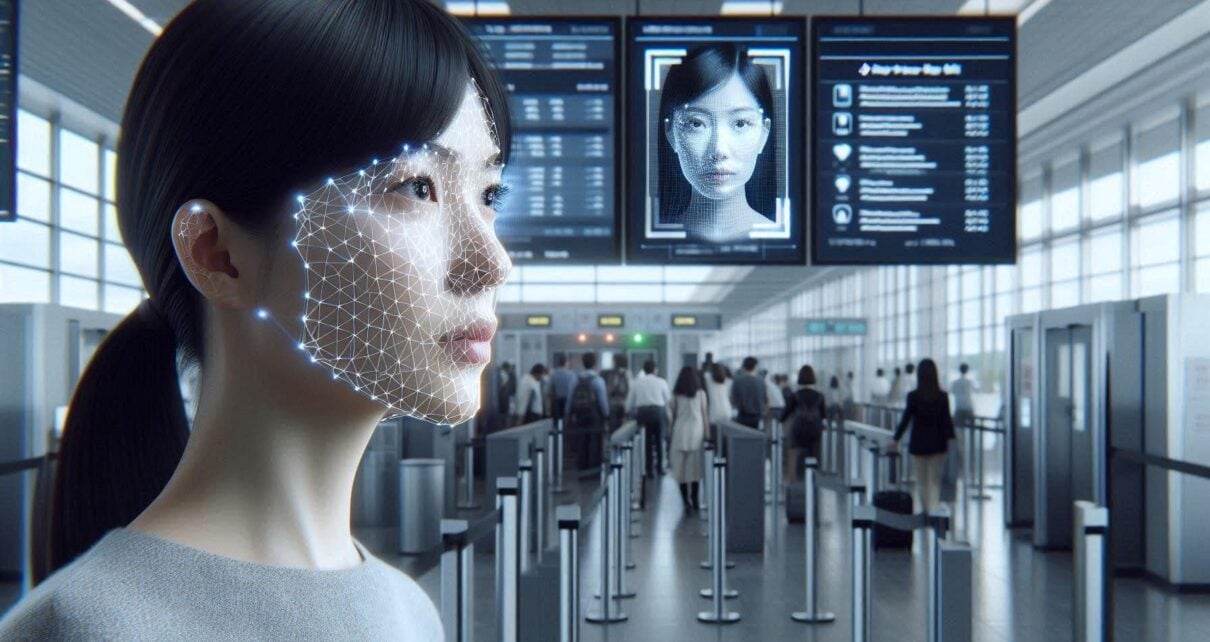
Once enrolled, passengers can move through checkpoints without repeatedly showing physical IDs.
WASHINGTON, D.C. — The familiar airport ritual of reaching for a passport at every checkpoint is beginning to disappear.
At participating airports, an enrolled traveler can check a bag, enter a security lane, pass immigration, and board an aircraft using facial recognition as the primary identity token. Cameras compare the passenger’s live image with verified travel credentials, allowing each checkpoint to confirm identity without repeatedly inspecting the same physical document.
The result is often called passport-free, document-free or token-less travel. Yet those descriptions require an important qualification: the passport has not ceased to matter.
Its information is usually verified earlier, either during mobile enrollment, at a kiosk or through a government travel database. The physical booklet may remain inside the passenger’s bag while a digital credential and biometric template perform the visible work.
The change is therefore not the elimination of identity documents. It is the movement of document checks away from individual airport counters and into a connected digital process.
One Enrollment, Multiple Checkpoints
In a conventional airport journey, the same passenger may present identification several times.
An airline employee checks a passport at bag drop. A security officer examines it again before screening. Border authorities may inspect it at departure or arrival, and the airline may request it once more at the boarding gate.
Each encounter serves a specific operational or legal purpose, but the repetition creates queues and requires passengers to keep valuable documents readily accessible.
Biometric travel systems attempt to replace that repeated presentation with a single enrollment.
The traveler’s passport data, flight information and facial image are verified and connected at the beginning of the journey. Later cameras can then determine whether the person standing at a checkpoint corresponds to the enrolled passenger.
If the match succeeds and the traveler is eligible to proceed, the system returns an approval. The passenger may not need to retrieve a passport or boarding pass at that location.
The face functions as a reusable link to a previously verified travel record.
What Enrollment Establishes
Enrollment is the point at which the system builds trust in the passenger’s digital identity.
A traveler may begin through an airline application, a government portal or an airport kiosk. The process can involve scanning the photo page of a passport, reading its electronic chip and taking a live selfie.
The system checks whether the document appears valid and whether the selfie resembles the photograph stored in the passport. Some applications also perform a liveness test intended to determine that a real person, rather than a printed picture or screen image, is present.
Once those checks succeed, the passenger’s identity can be linked with an itinerary.
The system may produce a biometric template derived from the face, a digital travel credential based on the passport, or a record indicating that the traveler has already met specific requirements.
These elements are not necessarily stored in one central location. Depending on the program, some information may remain in a digital wallet on the passenger’s phone, while other data may be processed by an airline, airport or government agency.
The Passport Moves Behind the Process
Electronic passports already contain a chip holding identity information and a digital facial image.
That chip helps a compatible reader verify that the data were issued by a recognized authority and have not been improperly altered. It also provides a trusted reference image against which the traveler’s live face can be compared.
An explanation of electronic passport technology and identity verification describes how the stored facial image supports automated comparisons at border checkpoints.
In a passport-free airport workflow, the information derived from that document can be authenticated before the passenger reaches the airport. The traveler then provides only the portion needed for a particular transaction.
A bag-drop system may need confirmation of identity and a valid baggage allowance. A security checkpoint may need to know that the person is an eligible ticketed passenger. A boarding gate may need identity, flight and boarding-status confirmation.
In principle, each participant does not need to receive the passenger’s complete identity file.
This approach is known as selective disclosure. It is intended to reduce unnecessary data sharing by allowing a traveler to prove a fact without revealing every field contained in the underlying document.
The Digital Travel Credential
A digital photograph of a passport is not the same as a digital travel credential.
A photograph or PDF can be copied or manipulated. A proper credential contains information that can be cryptographically checked against a trusted issuer. It is designed to allow an airline or government system to determine whether the data are authentic.
The credential may include biographical information derived from the passport, a reference to the traveler’s facial biometric, and evidence of travel authorization.
The International Air Transport Association’s One ID program envisions passengers obtaining necessary approvals before departure and moving through airport touchpoints without repeatedly showing physical documents.
Under that model, the passenger can arrive at the airport with much of the identity and admissibility work already completed.
The airport experience becomes a sequence of confirmations rather than a series of new document inspections.
Bag Drop Without the Counter
Self-service bag drop is one of the earliest places where reusable biometric identity can reduce friction.
A passenger approaches a machine, presents a face to the camera, and receives a match with the enrolled itinerary. The machine can retrieve the flight, verify baggage eligibility, print a tag and accept the suitcase.
Without biometric enrollment, the passenger might need to scan a boarding pass and, on an international itinerary, present a passport to an employee or document reader.
Automating the identity step can reduce counter traffic, particularly when most passengers have already checked in online.
It does not eliminate every reason for staff involvement. Oversized bags, payment disputes, documentation problems, and special-service requests may still require an employee.
Biometrics can simplify the routine transaction. They cannot resolve every exception.
Security Access Becomes an Identity Query
At the entrance to a security checkpoint, the central question is whether the person seeking access is an eligible traveler.
A biometric lane can photograph the passenger and compare the image with an approved reference. If the identity and flight status are confirmed, the passenger proceeds to physical screening.
The security process itself remains separate.
Facial recognition does not detect prohibited items in luggage or replace body-scanning equipment. It changes the method used to confirm who is entering the controlled area.
This distinction can be obscured by the broad phrase biometric security. At most airport checkpoints, facial comparison is an identity-verification tool embedded within a much larger screening system.
A successful match does not mean the passenger bypasses ordinary security rules.
Immigration Carries Different Legal Weight
The meaning of a biometric checkpoint changes when the traveler crosses an international border.
Airline bag drop and some security programs may be voluntary or offer a conventional document-checking alternative. Immigration authorities operate under national laws that can require foreign travelers to provide photographs, fingerprints or other identifying information.
In the United States, biometric entry and exit systems compare live photographs with travel-document images and government records. The legal position and available opt-out procedures can differ by citizenship and by whether the traveler is entering or leaving the country.
The expansion of U.S. facial collection for noncitizens illustrates how government-mandated border processing can extend beyond voluntary airline convenience programs, as reported by Reuters.
A person who can decline an airline’s facial boarding option may still be subject to legally required biometric collection at immigration.
Passengers should not assume that one airport-wide policy governs every camera they encounter.
Boarding Without Showing a Boarding Pass
At the gate, a live facial image can be compared with a preassembled gallery of passengers expected on the flight.
When the comparison reaches the required confidence level, the boarding system retrieves the passenger’s record and marks that person as boarded. An automated barrier may open, or an airline employee may receive an approval on a screen.
The process can eliminate the need to scan a phone or hand a paper boarding pass to an agent.
It can also reduce problems caused by dim phone screens, damaged barcodes and passengers searching through bags for documents while a line forms behind them.
Airlines gain a more automated record of who boarded. Passengers gain a shorter visible transaction.
The benefit depends on reliable integration between the facial-matching service and the airline’s departure-control system. If those systems lose connectivity or exchange incorrect information, the document-free lane can stop immediately.
Why “Passport-Free” Can Be Misleading
A traveler should not interpret passport-free boarding as permission to leave the physical passport at home.
International airlines remain responsible for confirming that passengers possess the documents required by destination and transit countries. Border officers may demand the original booklet. Automated equipment can fail, and a passenger can be selected for manual examination.
The term describes how a person moves through enabled airport checkpoints after enrollment. It does not amend national entry laws or replace the underlying passport’s legal status.
Even highly digital journeys can encounter destinations, transfer airports or individual gates that do not participate in the same system.
A traveler may move through one airport without showing a document and be required to present it during the next connection.
For the foreseeable future, the safest practice is to carry every required physical travel document, even when the planned airport experience is touchless.
The Interoperability Challenge
A seamless journey requires airlines, airports and governments to recognize compatible credentials.
That is difficult because travel systems have developed independently. One airport may enroll passengers through an airline application, while another relies on a government photograph gallery. A third may use a proprietary airport account.
If each location requires a new enrollment, the traveler has not gained a truly reusable identity. The process has merely replaced repeated passport checks with repeated biometric registrations.
Global standards aim to let a credential created in one trusted environment work in another. This requires agreement on data formats, security, consent, revocation, and responsibility when something goes wrong.
It also requires governments to accept digital evidence that a passenger has the right to travel.
Technical compatibility alone is insufficient. The receiving organization must trust the authority that issued the credential.
Who Confirms Permission to Travel
Identity and admissibility are related but different questions.
A biometric match may confirm that a traveler is the person named in a passport. It does not prove that the traveler holds a valid visa, meets health requirements, or has permission to enter the destination country.
Today, airlines often check those conditions at a counter or gate. Employees review passports, visas and electronic authorization systems because carriers may face fines or removal costs for transporting inadmissible passengers.
A complete document-free journey moves these checks earlier.
The passenger can submit required information digitally, receive an authorization or readiness notification, and share it with the airline. The carrier then knows before arrival at the airport that the traveler appears to meet the destination’s conditions.
This shift could remove one of the largest remaining reasons for manual inspection at international departure gates.
It also raises the stakes of incorrect or outdated digital information. If an authorization is revoked or a rule change shortly before departure, connected systems must update quickly.
A Face Is Convenient but Permanent
Biometric identity offers a form of convenience that passwords and cards cannot provide. Passengers do not need to remember a code, locate a document or carry an additional token.
That same characteristic creates risk.
A compromised password can be changed. A face cannot be replaced. Although systems usually compare mathematical templates rather than ordinary photographs alone, those templates are still sensitive personal information.
The danger is not limited to someone reconstructing a recognizable face. Stolen biometric data could potentially be used to test identity systems, correlate records or support impersonation attempts.
Document-free travel therefore requires strong encryption, tightly limited access and rules that prevent data collected for boarding from being reused without authority.
Examples of facial-database exposure, including the incident described in this facial-recognition data leak review, show why convenience must be paired with disciplined information security.
Retention Policies Are Not Uniform
Passengers may encounter several organizations during a single biometric journey, each operating under different retention rules.
A government agency may establish one period for citizen photographs and another for foreign-national records. An airline may retain transaction information under its privacy policy. A technology provider may process images without being permitted to keep them after the match.
The airport itself may operate the camera while never receiving the complete government-held identity record.
This fragmented structure makes simple statements such as “the airport deletes your face” inadequate.
Travelers need to know which organization collected the image, whether it kept the photograph or only a transaction record, how long the information remains available, and whether it can be shared for another purpose.
Clear signage should identify the responsible party and provide a practical path to more detailed information.
When Facial Recognition Fails
No biometric system matches every legitimate traveler successfully.
A reference image may be old. A passenger’s appearance may have changed because of aging, surgery, injury or facial hair. Reflections from glasses, poor lighting, head coverings and camera positioning can reduce image quality.
Algorithms can also produce false nonmatches even when both images show the same person.
When that happens, the passenger should be directed to manual verification. An employee can inspect the physical passport, review the boarding record and determine whether additional checks are necessary.
Failure to match should not automatically be treated as evidence of fraud.
Human fallback procedures are a basic requirement for any system used in a high-consequence setting. A passenger should not miss a flight solely because a camera could not produce a confident comparison.
Opting Out Requires a Real Alternative
Where biometric participation is voluntary, travelers should be able to request a conventional document check.
That choice needs to be meaningful. A manual lane that is hidden, severely delayed or accompanied by unfavorable treatment can pressure passengers to accept facial scanning even when the program is formally optional.
Policies also need to distinguish airline-operated boarding from government border inspection.
A traveler may be able to opt out at one touchpoint but not another. Citizenship, immigration status and local law can affect the answer.
Passengers who prefer manual verification should ask before entering the camera’s capture zone and keep their physical documents ready.
Airport employees, meanwhile, need training to explain the available options accurately rather than giving a single answer for every system in the terminal.
The New Airport Sequence
The emerging journey begins before arrival at the airport.
A passenger creates or retrieves a trusted digital identity, shares necessary travel information, and receives confirmation of eligibility. At the airport, the person’s face reconnects that identity with each authorized service.
Bag drop confirms the itinerary. Security confirms access. Immigration records the border movement. Boarding confirms entry to the aircraft.
Each checkpoint still performs a separate function, but it no longer needs to begin by reading the same physical document.
The promise is a smoother airport with shorter transactions and fewer queues. The challenge is building a system that remains secure, transparent and usable when technology fails.
Passport-free boarding is therefore less about abolishing the passport than about changing where trust is established.
The document remains the legal foundation. The digital credential carries its verified information. The face becomes the key that retrieves only what the next checkpoint needs.
For passengers, the most noticeable change may be what they no longer have to do: stop, search for a booklet and present it again.
