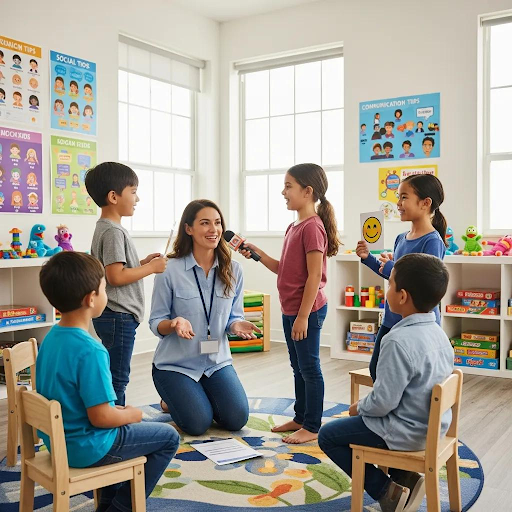
When a child, teen, or adult is struggling with social anxiety, difficulty connecting with peers, or challenges navigating everyday social situations, the first instinct for most families is to seek out one-on-one counseling. That instinct makes sense — individual therapy is the most familiar format, and it works well for a lot of things. But when the core challenge is social in nature, one-on-one therapy has a structural limitation that’s hard to work around: you can’t practice real social interaction with just one other person in the room.
This is the fundamental reason social skills groups often produce results that individual counseling alone can’t replicate — especially for children and adults on the autism spectrum, those with developmental disabilities, or anyone whose anxiety around social situations has been getting in the way of forming genuine connections.
The Problem With Learning Social Skills Without Practicing Them
Traditional approaches to social skills development often focus on teaching rules — how to make eye contact, how to take turns in a conversation, how to read facial expressions. Those are useful things to know, but knowing them and being able to apply them in the moment under the pressure of a real social situation are two very different things. It’s similar to studying a language from a textbook versus actually speaking it with other people. The textbook gives you the vocabulary and grammar. The real conversation is where you actually learn.
Social skills groups close that gap because the practice happens in the group itself. Participants aren’t just listening to instructions about how to engage — they’re engaging, in real time, with real peers who have their own communication styles, their own ways of responding, and their own social dynamics. The group is the practice environment, which means the skills being learned are being tested against the exact kind of unpredictability that makes social situations difficult in the first place. That’s a fundamentally different experience from role-playing scenarios with a single therapist.
Why This Matters Specifically for Autism Spectrum Disorder
For individuals with autism spectrum disorder, the challenge of social interaction is often less about not wanting connection and more about not having reliable access to the patterns and cues that neurotypical people process automatically. Eye contact that feels natural to most people can feel overwhelming. Knowing when it’s your turn to speak, how to interpret an ambiguous comment, how to recover when a conversation goes in an unexpected direction — these are skills that most people develop through thousands of small social interactions over time. For people with ASD, those interactions are often more difficult, more draining, and less successful, which can create a cycle of avoidance that limits the very experiences needed to build the skills.
A well-structured social skills group creates a controlled but genuine peer environment where those interactions can happen with appropriate support and feedback. The group leader provides real-time guidance without removing the authenticity of the peer interaction. Over time, participants build a practical toolkit for navigating social situations — not a set of memorized rules, but actual practiced experience with a widening range of social dynamics.
The same applies to individuals with developmental disabilities who struggle with communication, reading social cues, or managing the anxiety that comes with unfamiliar social situations. The peer element of group work is what makes it different, and what makes the skills more likely to transfer to school, work, and daily life outside the program.
The Role of Anxiety in Social Difficulty — and How Groups Address It
For many participants, social anxiety isn’t just a byproduct of social difficulty — it’s a primary driver of it. The anticipation of a social situation produces enough discomfort that avoidance feels like the only rational response. Over time, avoidance reduces anxiety in the short term while reinforcing it in the long term, because the feared situation never gets tested against reality.
Group participation gradually and safely challenges that pattern. Being in a room — or a virtual session — with peers who are working through similar challenges reduces the isolation that feeds social anxiety. Repeated positive interactions, even small ones, build genuine evidence that contradicts the anxious prediction that every social situation will go wrong. Participants who come in with significant anxiety around social situations often report meaningful decreases in that anxiety over time — not because the anxiety was talked about, but because the group gave them experiences that changed the underlying belief driving it.
Online social skills training groups make this accessible to people regardless of where they live, which is significant given that quality social skills programs have historically been concentrated in major metropolitan areas. Someone in a smaller city or rural area who has been told they’d have to drive hours to access a good program can now participate from home — which also tends to reduce the initial anxiety barrier for people who are just getting started.

Is a Social Skills Group the Right Fit?
Social skills groups aren’t the right answer for every situation, and the honest version of this conversation acknowledges that. Individual counseling services remain the better choice for certain underlying issues — trauma, depression, or other mental health challenges that need direct therapeutic attention before group work is appropriate. But for children, teens, and adults whose primary challenge is the social domain itself — connecting, communicating, managing the anxiety around social situations, building self-esteem through genuine peer relationships — group-based work tends to be both more efficient and more effective than individual work alone.
For families or individuals trying to figure out whether this format makes sense for their specific situation, the clearest next step is a direct conversation rather than trying to make that determination from a webpage. Finding out whether a social skills group is the right fit starts with an assessment that looks at the specific challenges, goals, and circumstances involved — and produces an honest answer rather than a sales pitch.
The research on group-based social skills intervention is clear enough that it’s no longer a novel approach. What’s changed is accessibility — and for families who have been waiting for a quality program to be within reach, that change is a meaningful one.