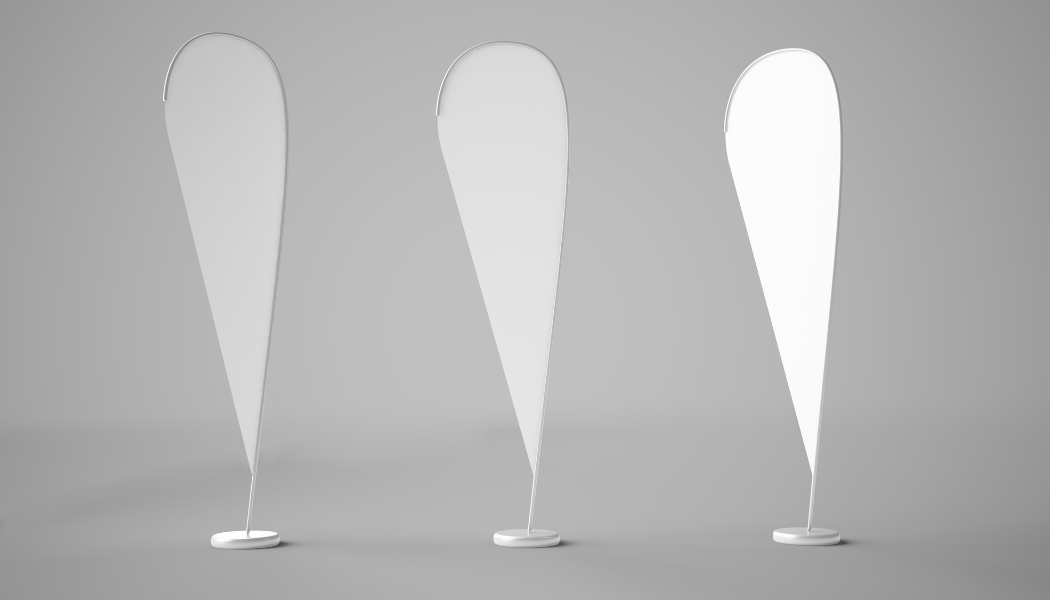
We live in an era where we are constantly bombarded by pixels. You open your phone to check the weather, and an ad pops up. You watch a video, and you have to wait five seconds to skip a commercial. As a result, our brains subconsciously filter out anything that looks like a promotion on a screen. We scroll right past it without even registering the brand name. But step outside, and the rules of engagement change.
If you are driving down the street and see a bright yellow swoosh of fabric snapping in the wind, you look. You can’t help it. It’s instinct. It cuts through the static of the real world in a way that a digital banner simply cannot.
This is why, despite the modern obsession with algorithms and click-through rates, humble advertising flags remain one of the most lethal tools in a local business’s arsenal. They don’t require a monthly subscription, they don’t get blocked by ad-blockers, and they work 24 hours a day. If you are looking to drive foot traffic without blowing your budget on a complex digital campaign, here is the science and strategy behind why physical banners still win.
1. The Biology of Attention
The primary reason feather flags and banners work isn’t that they are pretty; it’s because they move. Human beings are hardwired to notice motion. Thousands of years ago, seeing movement in our peripheral vision meant a predator was approaching. Today, that same instinct means that when a colorful flag flutters on the sidewalk, our eyes automatically snap toward it.
Compare this to a standard metal sign or a window decal. Those are static. Once a commuter has driven past your shop twice, that sign becomes part of the background scenery. It’s just “furniture.” A fabric banner is dynamic. It changes shape. It responds to the wind. That chaotic movement prevents the brain from ignoring it. It forces the driver to look at your logo every single morning, re-establishing your presence daily.
2. The Cost Per Stare Equation
In the digital marketing world, we obsess over cost per thousand (CPM). If you run a local ad on social media, you might pay $10 or $20 just to have 1,000 people scroll past your post for half a second. Once your budget runs out, the ad disappears.
Physical banners break this math. Let’s say you spend $100 on a high-quality, double-sided flag setup. If your business is on a road with a traffic count of 5,000 cars a day, that banner is generating 150,000 impressions a month. Over the course of a year, that is 1.8 million views. Your cost per impression is so low that it is almost incalculable. It is a one-time capital expense that continues to yield returns for as long as the fabric holds together. There is no daily budget to manage. It is simply there, working for you, rain or shine.
3. Catching the High-Intent Customer
Digital ads are often interruptive. They catch people when they are trying to do something else (watch a movie, talk to friends). Sidewalk banners catch people when they are already in “transaction mode.”
Think about the psychology of a person driving or walking past your store. They might be hungry, or they might realize their car is making a weird noise. Or, they might remember they need a haircut.
When they see a giant flag that says “TACOS,” “OIL CHANGE,” or “WALK-INS WELCOME,” it triggers an immediate solution to a current problem. This is the “impulse capture.” You aren’t trying to convince someone sitting on their couch to get in their car and drive to you. You are convincing the person who is already outside to turn the steering wheel right now. That is a much easier sale to make.
4. Signaling Open for Business
There is a subtle trust factor at play with physical signage. Have you ever driven past a strip mall and wondered if a store was actually open? Maybe the windows are tinted dark, or the Open sign is dim. If a customer is unsure, they usually keep driving. They don’t want to risk the embarrassment of pulling on a locked door.
A banner placed outside is the universal symbol of “We are here, and we are ready.” It signals activity. It makes a grand opening feel grand, and it makes a standard Tuesday feel like an event. It removes the friction of doubt. If the flags are out, the business is alive. This is particularly crucial for businesses set back from the road or tucked into the corner of a shopping center where visibility is poor. The flag acts as a waypoint, guiding people to your front door.
5. Hyper-Local Dominance
Finally, banners allow you to own your sidewalk. In a crowded marketplace, physical space is a premium. If you own a tax business, and your competitor down the street is just a door in a wall, but you have a row of patriotic banners lining your walkway, you look like the market leader. You look like the “main” location.
This is about claiming territory. It creates a visual footprint that is larger than your actual square footage. It tells the neighborhood, “We are proud of this business.” Competitors can outbid you on Google Keywords. They can outspend you on radio ads, but they cannot block the view of your banner on your own property. It is the one advertising channel where you have total control.
A Simple Yet Effective Solution
We often overcomplicate marketing. We build funnels and analyze heat maps, but sometimes, the most effective way to get a customer is to wave at them. Advertising banners are effective because they are simple, primal, and impossible to ignore. They turn the wasted space of a sidewalk into a 24/7 salesperson. If you want to drum up business, don’t just look at your screen—look out your window. If there isn’t a flag there, you’re leaving money on the table.