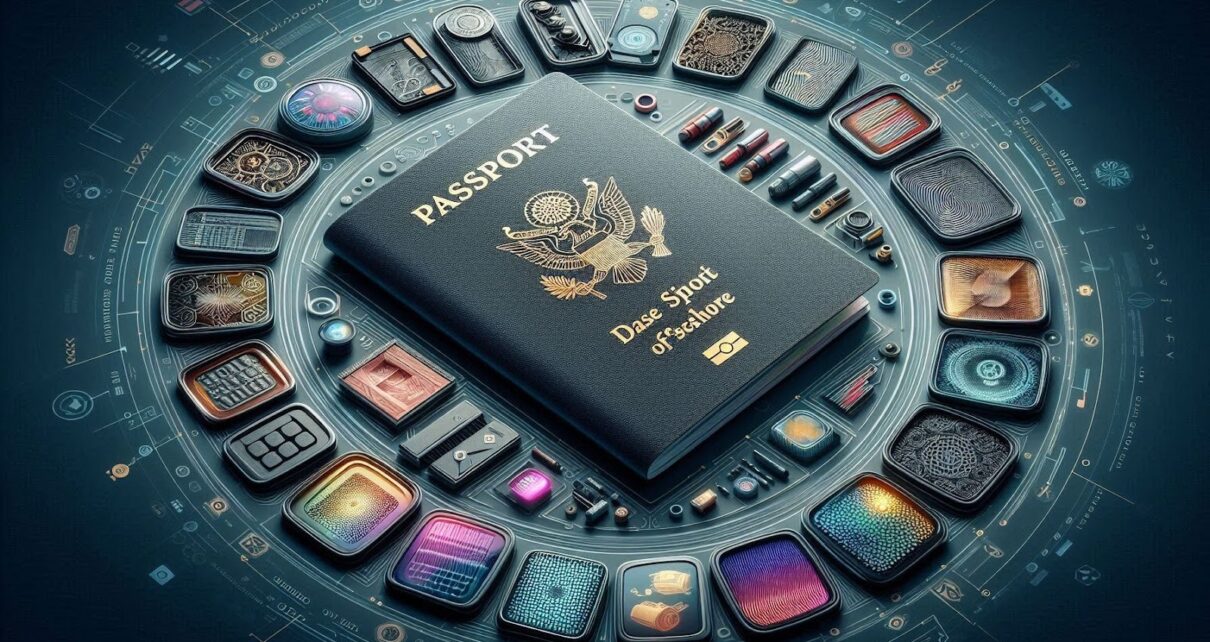
Microprinting remains one of the most effective passport security features because it is difficult to copy with ordinary printing tools.
WASHINGTON, DC
A modern passport is built around an uncomfortable truth for counterfeiters: the smallest details are often the hardest ones to fake. A forged document may get the broad look of a passport roughly right, the cover color, the layout, the photo placement, and the official tone of the design. But once an examiner moves closer, the deception often begins to unravel. Tiny printed text that should stay crisp becomes blurred. Fine line work breaks down. Hidden security details that should hold together under magnification start to smear, thicken, or disappear.
That is why microprinting remains one of the most effective passport security features in 2026. It does not dominate the page the way a hologram does. It does not announce itself to travelers the way a chip symbol might. Instead, it sits quietly inside borders, background lines, and design elements, waiting for a trained eye, a magnifier, or a scanner to expose the difference between a genuine document and a weak imitation. The U.S. State Department’s overview of the Next Generation Passport makes clear that modern passports are built as hardened identity products with upgraded physical protections, not just attractive booklets.
Microprinting works because it punishes copying.
The power of microprinting comes from a very simple idea. It forces counterfeiters to reproduce precision, not just appearance. To the naked eye, microprinted text may look like a line, a border, or a decorative pattern. Under magnification, it reveals itself as actual text or highly controlled fine detail. If the document is genuine, that tiny text stays sharp. If the document has been copied, scanned, reprinted, or rebuilt using lower-grade tools, the same area often turns fuzzy or breaks apart.
That is exactly why governments continue to rely on it. In official passport and visa reciprocity descriptions for several countries, the U.S. State Department notes that microprinting is meant to remain visible only under magnification and that it can smudge or degrade when photocopied or scanned. That is the point. Microprinting is designed to expose the weakness of ordinary copying methods. A page may look official from a distance, yet fail once it is challenged at the level of detail where real document security lives.
Why tiny text matters so much at the border.
Border officers do not inspect passports only by looking at them from arm’s length. They are trained to challenge them. They tilt the page, check the laminate, compare the photo, review the machine-readable zone, and when necessary, inspect the printing more closely. Microprinting matters because it gives them another way to turn the document into a test.
A counterfeit passport may survive a casual glance. It is much less likely to survive a sequence of technical checks. If the background line that should resolve into text remains a muddy stripe, or if the hidden microdetail breaks apart under magnification, that can become the first quiet sign that the document is not what it claims to be. Microprinting is effective because it does not ask much from the officer. It asks for the passport to prove that it was produced with the right level of control.
That makes it a particularly useful frontline feature. It is small, but it is unforgiving. Once the printing quality drops below the level of a genuine document, the weakness shows.
Microprinting is strongest when it disappears into the design.
One reason microprinting remains so useful is that it works best when most people do not even notice it. It can be built into page borders, woven into background patterns, or placed inside lines that appear decorative from a distance. That makes it difficult for counterfeiters to isolate and reproduce convincingly, especially if they are working from photographs, scans, or incomplete reference material.
This is one of the recurring themes in modern passport security. A genuine document is not protected by a single dramatic feature. It is protected by many small, overlapping ones. In its backgrounder on the high-tech features that make passports secure, Amicus International Consulting points to the broader mix of physical and digital protections, including machine-readable zones, biometric features, and visible anti-counterfeit devices. Microprinting fits naturally into that same logic. Its value is not only that it is hard to print well. Its value is that it quietly reinforces the rest of the document’s trust structure.
Because it blends into the design, it also forces counterfeiters to chase perfection in areas they may overlook. The document cannot just be broadly convincing. It has to be technically convincing in places most people will never notice, but trained examiners absolutely will.
The best counterfeit may still fail in the fine detail.
This is what makes microprinting such a frustrating obstacle for fraudsters. Many forgeries are built for distance, not scrutiny. They are designed to look persuasive in a quick exchange, at a hotel desk, in a rushed transaction, or in the hands of someone who is not trained to inspect identity documents. But a passport is not a casual document. It is meant to be challenged by people and systems that assume fraud is possible.
That is where microprinting changes the game. A fake can imitate color. It can imitate spacing. It can even imitate a complex layout. But the moment it has to reproduce tiny, legible detail that holds up under magnification, the margin for error collapses. Lines thicken. Edges soften. Letter shapes merge. What looked official from a distance starts to look mechanically wrong up close.
This is also why microprinting continues to appear alongside holograms, UV features, latent images, and tactile printing in secure travel documents around the world. Governments keep using it because it keeps doing what it was designed to do: reveal the difference between high-control security printing and ordinary reproduction.
Microprinting protects the document, not just the data page.
Another reason this feature matters is that it helps defend the integrity of the document beyond the obvious identity fields. A passport is not secure just because the main photo page looks difficult to alter. The surrounding design, borders, lines, and printing logic all help prove whether the booklet is genuine. Microprinting supports that wider mission by making the page harder to reproduce as a whole.
In practice, that means a criminal trying to fake the passport cannot focus only on the name, number, and photograph. The entire printing environment becomes part of the challenge. Tiny design elements in the background can become as important as the main biographical text. Once that is understood, the logic of modern passport security becomes clearer. Authenticity is not carried by one line of text. It is distributed across the document.
That distribution is exactly what makes fraud harder. If the counterfeiter misses even one of those quiet details, the booklet begins to lose credibility.
Digital border systems have made physical printing even more important.
It might seem that in an era of facial recognition and chip verification, a classic print feature such as microprinting would matter less. The opposite is closer to the truth. The physical document still has to survive the first round of scrutiny before the deeper digital systems fully come into play. If the booklet looks wrong, feels wrong, or fails on basic inspection, the traveler can be pushed into deeper review long before the chip or biometric comparison offers any rescue.
That broader environment is getting more demanding. A recent Reuters report on expanded facial recognition at U.S. borders highlighted how the United States is tying document inspection more closely to biometric checks intended to combat passport fraud and visa overstays. That trend raises the stakes for counterfeiters. The passport must now survive both physical examination and identity matching. Microprinting remains relevant because it helps decide whether the document even deserves to advance to that next layer of trust.
In other words, the smaller print feature has not been pushed aside by technology. It has become one of the filters that decides whether the document gets the benefit of the doubt in a much more sophisticated screening system.
Why the tiniest details still stop the biggest fraud attempts.
The real strength of microprinting is that it embodies the deeper philosophy of passport security. A secure passport is not built to win one dramatic showdown. It is built to pass a sequence of small tests. The paper should behave correctly. The hologram should shift correctly. The hidden UV features should appear correctly. The machine-readable zone should scan correctly. And the tiny printed details that most travelers never notice should remain sharp when the document is challenged up close.
That is why microprinting still matters so much in 2026. It turns ordinary copying tools into liabilities. It transforms magnification into a fraud test. And it reminds counterfeiters that in secure document design, the smallest weakness can become the biggest problem.
A passport may look official from a distance. Microprinting helps determine whether it can still look official when the inspection gets real.